

For decades, Gross Domestic Product has been the shorthand for national progress. When GDP rises, governments celebrate. When it falls, headlines warn of trouble. International institutions rank countries by it. Investors watch it. Politicians campaign on it.
But GDP was never designed to measure human well-being. It was designed to measure economic output. The two are not the same. A country can grow its GDP while its citizens become more anxious, its environment degrades, and its public services crumble. Conversely, some of the most valuable things in life — health, relationships, security, leisure, clean air, safe neighbourhoods — contribute nothing to GDP until they are bought, sold, or repaired.
This Accra Dail Mail article explains why Ghana, and the world, should stop treating GDP as the sole measure of success. It is not an argument against economic growth. It is an argument for a broader, more honest way of thinking about what progress means.
Quick Facts
-
GDP measures the monetary value of all final goods and services produced in a country during a given period.
-
GDP was developed in the 1930s and 1940s, primarily as a tool for measuring wartime production capacity.
-
GDP does not measure income distribution, environmental health, unpaid work, leisure, or quality of life.
-
A country can have rising GDP and rising inequality at the same time.
-
Alternative measures, such as the Human Development Index and the Genuine Progress Indicator, attempt to capture broader dimensions of well-being.
-
Ghana’s official GDP figures are produced by the Ghana Statistical Service, which also collects data on poverty, employment, and living conditions.
-
The Sustainable Development Goals adopted by the United Nations recognise that progress must be measured across multiple dimensions.
What GDP Actually Measures
GDP is the total market value of all final goods and services produced within a country’s borders in a year or a quarter. It counts what is bought and sold. It adds up consumption, investment, government spending, and net exports.

GDP is useful for what it is: a measure of economic activity. It tells you whether the economy is producing more or less than it did before. It helps governments plan budgets, central banks set interest rates, and investors allocate capital.
But GDP has never been a measure of welfare. It does not ask whether the activity being counted is good or bad. It does not ask who benefits. It does not ask whether the growth can be sustained. It simply counts.
The Problem with Using GDP as a Scorecard
GDP Counts Harmful Activity as Growth
If a factory pollutes a river and the government spends money cleaning it up, GDP rises twice: once for the factory’s production and once for the clean-up. The destruction of natural assets is not subtracted from GDP. The cost of repairing damage is added.

If a traffic accident destroys vehicles and injures people, GDP rises through the spending on repairs, medical care, and insurance administration. The pain and loss are not counted. The economic activity generated by the accident is.
This is not a flaw in GDP as a statistical tool. It is a flaw in using GDP as a measure of success. GDP is indifferent to whether activity is constructive or destructive.
GDP Ignores Unpaid Work
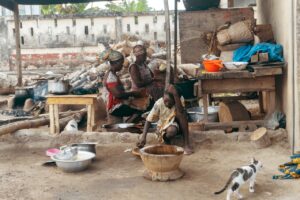
In Ghana, as in many countries, a great deal of essential work is unpaid. Women and men care for children, cook meals, clean homes, support elderly relatives, and contribute to family farms and businesses without receiving wages. None of this appears in GDP.

If a woman stays home to care for her children, her work is invisible in the national accounts. If she hires a nanny and goes to work, GDP rises: the nanny is paid, the woman earns a salary, and both activities are counted. The actual amount of care may not have changed, but GDP has increased.
This is not a neutral omission. It systematically undervalues the contributions of women, the informal economy, and the household sector.
GDP Says Nothing About Distribution
GDP measures total output. It does not tell you who receives the income generated by that output. A country can experience rapid GDP growth while the benefits flow entirely to a small elite. The majority can see their living standards stagnate or decline even as the national average rises.
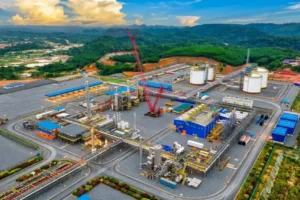
In Ghana, economic growth has at times been driven by capital-intensive sectors like mining and oil. These sectors generate large output values but employ relatively few people. GDP rises, but the link to household incomes and job creation is weak. If policy is judged solely by GDP growth, this structural problem can be hidden.
GDP Ignores Environmental Costs
GDP treats natural resources as free inputs. If a country cuts down its forests, mines its minerals, and depletes its fisheries, GDP rises. The loss of natural capital — the forests, the clean water, the soil fertility, the biodiversity — is not deducted.
This creates a perverse incentive. A country can grow its GDP by liquidating its natural wealth, and the statistics will record the growth as progress, even though the country is actually becoming poorer in terms of its long-term assets.
Ghana’s history with gold, timber, and oil illustrates the point. Exporting raw materials raises GDP, but the depletion of the resource and the environmental damage are not fully accounted for.
GDP Does Not Measure Quality of Life
A person can live in a country with high GDP and have a poor quality of life. Long working hours, stressful commutes, polluted air, unsafe streets, and weak social connections all reduce well-being without reducing GDP. In fact, some of these problems increase GDP — spending on security, healthcare for stress-related illness, and commuting all add to economic activity.
Conversely, many of the things that make life worth living — time with family, friendship, community, religious practice, rest, natural beauty — contribute nothing to GDP unless money changes hands.
GDP Was Never Meant to Be a National Scorecard
The economist Simon Kuznets, who helped develop the concept of national income accounting, warned against using it as a measure of welfare. He understood that national income is a measure of economic activity, not of well-being. Yet the world has often ignored that warning.
GDP became entrenched after World War II because it was useful, comparable across countries, and relatively easy to calculate. But usefulness for a specific purpose is not the same as suitability as a universal measure of progress.
What the Alternative Measures Capture
The Human Development Index
The Human Development Index, developed by the United Nations Development Programme, combines three dimensions: health (measured by life expectancy), education (measured by years of schooling), and income (measured by Gross National Income per capita). It is a broader measure than GDP, though it still has limitations.
Ghana’s HDI ranking has improved over the years, but it is lower than its GDP ranking in many comparisons. This reflects the fact that economic output does not automatically translate into health and education outcomes.
The Genuine Progress Indicator
The Genuine Progress Indicator attempts to adjust GDP by adding the value of unpaid work and subtracting the costs of pollution, crime, and resource depletion. The result is a measure that is closer to sustainable well-being, though it is more difficult to calculate.
Multidimensional Poverty Measures
Multidimensional poverty measures, used by the United Nations and others, look beyond income to capture deprivation in health, education, and living standards. A household may have income above a poverty line but still be deprived in other dimensions. These measures reveal a more complex picture than income alone.
The Sustainable Development Goals
The Sustainable Development Goals, adopted by all United Nations member states in 2015, recognise that progress must be measured across economic, social, and environmental dimensions. The goals include targets on poverty, hunger, health, education, gender equality, clean water, decent work, inequality, climate, and governance. No single indicator — certainly not GDP — can capture progress on all these fronts.
Well-Being Surveys
Some countries are experimenting with well-being surveys that ask citizens directly about their life satisfaction, sense of purpose, and mental health. These subjective measures provide information that economic statistics cannot.
What This Means for Ghana
Ghana has made progress on many fronts. Economic growth has lifted millions out of poverty, and the country has moved from low-income to lower-middle-income status. These gains are real and should not be dismissed.
But the limitations of GDP are particularly relevant in Ghana’s context.
Growth Without Enough Jobs
Ghana has experienced periods of solid GDP growth without commensurate job creation. This is partly because growth has been driven by capital-intensive sectors. If the measure of success is only GDP, a government can claim progress even while unemployment remains high and informal work remains precarious.
Resource Depletion
Gold and oil have boosted Ghana’s GDP, but they are finite resources. Once extracted, they are gone. If the proceeds are not invested in renewable assets — education, infrastructure, institutions — the country may be trading long-term wealth for short-term output.
Inequality and Regional Disparities
GDP growth in Ghana has not eliminated regional disparities. The north and other areas continue to lag behind. A national GDP figure averages out these differences and can mask the experience of large parts of the population.
Environmental Pressures
Illegal mining, deforestation, and pollution are serious problems in Ghana. GDP counts the gold extracted, but it does not subtract the destroyed farmlands, polluted rivers, and degraded forests. If success is measured only by output, these losses remain invisible.
The Informal Sector
A large share of Ghana’s economy is informal. GDP estimates attempt to capture informal activity, but the measurement is imperfect. This means official GDP may understate the true scale of economic life, especially for ordinary Ghanaians.
What Should Replace GDP as the Scorecard?
The answer is not a single number. No single measure can capture everything that matters. Instead, progress should be assessed through a dashboard of indicators, including:
-
Median household income, not just average income
-
Employment and underemployment
-
Poverty and inequality measures
-
Health outcomes, including life expectancy and maternal mortality
-
Education quality and access
-
Environmental quality and natural resource depletion
-
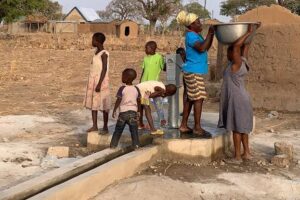
Access to basic services, including water, electricity, and sanitation
-
Safety and security
-
Perceived quality of life and life satisfaction
This is not a radical proposal. It is the approach already embedded in the Sustainable Development Goals and in the work of many statistical agencies. The challenge is political: governments prefer simple stories, and GDP provides one.
Common Misconceptions
“GDP is a measure of how well a country is doing”
GDP is a measure of economic output, not of well-being. It is one piece of information, not the whole story.
“If GDP is rising, life is improving for everyone”
GDP growth can coexist with rising inequality, environmental damage, and stagnant household incomes. Growth is not the same as shared progress.
“We should stop measuring GDP”
No. GDP is a useful statistical tool. The argument is not to abandon it but to stop treating it as the sole measure of success.
“Alternative measures are too complicated”
Some are more complex, but simpler alternatives exist. Even a small set of indicators — income, health, education, and environment — gives a fuller picture than GDP alone.
“This is only a Western concern”
The limitations of GDP matter in every country, including Ghana. The question is what kind of progress a country values and whether its statistics reflect that.
Frequently Asked Questions
Why is GDP still so widely used?
GDP is useful because it is standardised, comparable across countries, and relatively easy to calculate. It also has institutional inertia: governments, investors, and international bodies have built systems around it.
What does GDP tell us that is useful?
GDP tells us whether the economy is growing or shrinking. This matters for fiscal policy, monetary policy, and investment decisions. The problem is not the measure itself but its misuse.
How can Ghana measure progress beyond GDP?
Ghana already collects data on poverty, health, education, employment, and other indicators through the Ghana Statistical Service and other agencies. The task is to give these indicators equal weight in policy debates.
Is GDP growth bad for the environment?
Growth can harm the environment if it is based on resource extraction and pollution. But growth based on services, education, and clean technology can be compatible with environmental goals. The quality of growth matters, not just the quantity.
Can a country have high GDP and low well-being?
Yes. Several countries rank high on GDP but lower on measures of life satisfaction, mental health, and social cohesion. The relationship between income and well-being is not simple.
What can ordinary citizens do?
Citizens can ask better questions. Instead of asking only “how much did the economy grow?”, ask “who benefited?”, “what was the cost?”, and “is this progress sustainable?” The quality of public debate depends on the questions people ask.
What to Remember
GDP is a tool, not a goal. It measures the size of economic activity, not the quality of life. When governments, media, and citizens treat GDP as the ultimate measure of success, they make bad decisions and celebrate the wrong things.
Ghana’s progress should be judged by broader standards: whether people have jobs and incomes, whether children are learning, whether the sick can get care, whether the environment is protected, and whether communities are safe and cohesive.
The next time you hear a politician celebrate GDP growth, do not dismiss the number. But do not stop there either. Ask what the growth was made of, who benefited, and what it cost. Those questions lead to a more honest conversation about development — one that GDP alone cannot provide.
Source: The Accra Daily Mail

Samuel Kwame Boadu is a Ghanaian media entrepreneur and storyteller with a passion for amplifying urban voices and uncovering everyday truths. He is the Editor-in-Chief and Founder of The Accra Daily Mail, a dynamic digital platform dedicated to capturing the pulse of Ghana’s capital—its people, culture, challenges, business, sports and innovations.