



Every few months, news reports announce that Ghana’s economy has grown by a certain percentage. Politicians celebrate the figure. Critics point out that life feels harder for ordinary people. Both reactions can be true at the same time. The problem is that GDP, or Gross Domestic Product, is often quoted without any real explanation of what it measures and what it does not.
GDP is the most commonly used indicator of a country’s economic size and growth. It matters because it shapes government policy, influences investor confidence, and affects how international institutions assess Ghana. But GDP does not directly measure whether your salary can cover your rent or whether your business is thriving.
This article explains what GDP is, how it is calculated in Ghana, what it captures, what it misses, and why it matters to ordinary Ghanaians. It also tackles some of the most common misunderstandings about economic growth.
Quick Facts
-
GDP stands for Gross Domestic Product. It is the total monetary value of all goods and services produced within a country during a specific period.
-
The Ghana Statistical Service is the official body that calculates and publishes Ghana’s GDP figures.
-
Ghana reports GDP on a quarterly and annual basis.
-
GDP can be measured in current prices (nominal GDP) or adjusted for inflation (real GDP).
-
Economic growth refers to the percentage change in real GDP over time, usually year-on-year.
-
GDP growth does not automatically mean higher incomes, better jobs, or reduced poverty.
-
Ghana’s major sectors — services, agriculture, and industry — contribute to GDP in different proportions, and these proportions change over time.
What GDP Actually Is
Gross Domestic Product is a measure of economic activity. Specifically, it is the total value of all final goods and services produced within Ghana’s borders during a given period, typically a quarter or a year. The key words are “final,” “produced,” and “within.”
Final goods and services means GDP counts only finished products, not intermediate inputs. If a baker buys flour to make bread, the flour is not counted separately. The value of the bread already includes the flour. Counting both would double count the same activity.
Produced means GDP is about actual production, not simply spending or transfers. If you sell an old car, that transaction is not included because the car was not produced during the period. Only the service of selling, such as a dealer’s commission, would count.
Within means geographic boundaries. GDP includes production by foreign companies operating in Ghana and excludes production by Ghanaian companies operating abroad. This is different from Gross National Income, which includes income earned by Ghanaians abroad and excludes income sent out of the country by foreign firms.
When people say “the economy grew by 5%,” they usually mean real GDP grew by 5% compared with the previous year. Real GDP is adjusted for inflation, meaning it tries to measure actual increases in output rather than just increases in prices.
How GDP Is Measured
There are three main ways to calculate GDP: the production approach, the expenditure approach, and the income approach. In theory, all three should produce the same figure. In practice, they rely on different data sources.
The Production Approach
This is the most commonly used method in Ghana. It adds up the value added by each sector of the economy: agriculture, industry, and services. Value added is the value of output minus the cost of intermediate inputs. This avoids double counting.
The Ghana Statistical Service collects data from businesses, farms, government agencies, and other sources to estimate how much each sector produced during the quarter or year. It then sums these estimates to arrive at total GDP.
The Expenditure Approach
This method adds up all spending on final goods and services. It includes household consumption, government spending, investment by businesses, and net exports (exports minus imports). The expenditure approach is useful for understanding what is driving growth: Is it consumption, investment, government spending, or trade?
The Income Approach
This method adds up all income earned in the economy, including wages, profits, rents, and interest. It is less commonly used as the primary method in Ghana because income data can be difficult to collect, especially in the informal sector.
Nominal vs Real GDP
One of the most important distinctions is between nominal GDP and real GDP.
Nominal GDP measures the value of goods and services at current prices. If prices rise, nominal GDP can increase even if the actual quantity of goods and services produced stays the same. This makes nominal figures useful for comparing the size of the economy over short periods but misleading for measuring growth.
Real GDP adjusts for inflation. It measures the volume of production using constant prices from a base year. This allows meaningful comparison over time. When the Ghana Statistical Service reports that the economy grew by a certain percentage, it is referring to real GDP growth, which has removed the effect of price changes.
For example, if nominal GDP rises by 30% but inflation is 25%, real GDP growth would be roughly 5%. The economy produced more goods and services, but not as much more as the raw cedi figure suggests.
What Counts Toward GDP in Ghana
Ghana’s economy is divided into three broad sectors: agriculture, industry, and services.
Agriculture
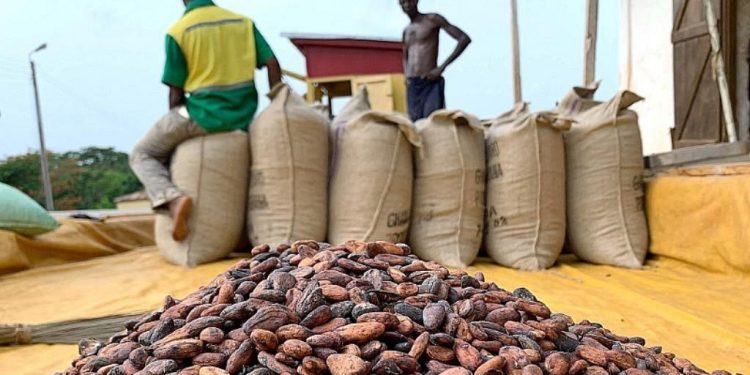
Agriculture covers crop production, livestock, forestry, and fishing. The main crops are cocoa, maize, rice, cassava, yam, plantain, vegetables, and oil palm. Cocoa is particularly important because it is a major export crop and source of foreign exchange.
Agriculture’s share of GDP has declined over the decades as services and industry have grown. However, agriculture still employs a large share of the workforce, especially in rural areas. This creates an interesting situation: a sector can contribute a smaller share to GDP while still supporting many livelihoods. GDP measures output value, not employment.
Industry
Industry includes mining and quarrying, manufacturing, construction, electricity, water, and oil and gas. Gold is the most significant mineral export. Crude oil and natural gas have grown in importance since commercial production began in 2010.
Mining and quarrying can swing GDP figures significantly. When gold or oil prices rise, or when production volumes increase, the industry sector can grow quickly. When global prices fall or technical problems disrupt production, the sector can contract. These swings affect overall GDP growth without necessarily reflecting what is happening in the rest of the economy.
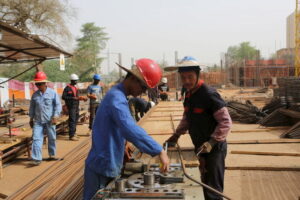
Manufacturing remains relatively small compared with services and agriculture. Construction also plays a significant role, linked to housing, roads, and other infrastructure projects.
Services
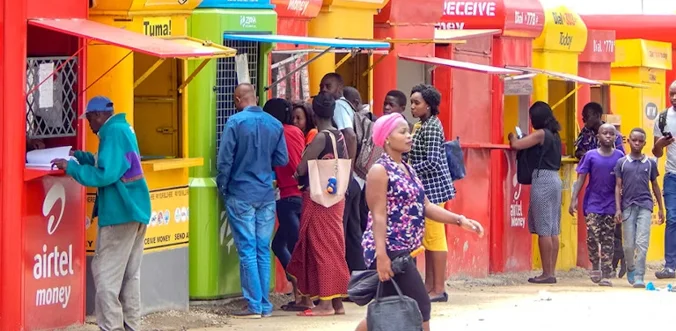
Services is the largest sector. It includes trade, transport, information and communication, finance and insurance, real estate, public administration, education, health, and hospitality. Mobile money transactions, banking services, consulting, teaching, and retail trade all fall here.
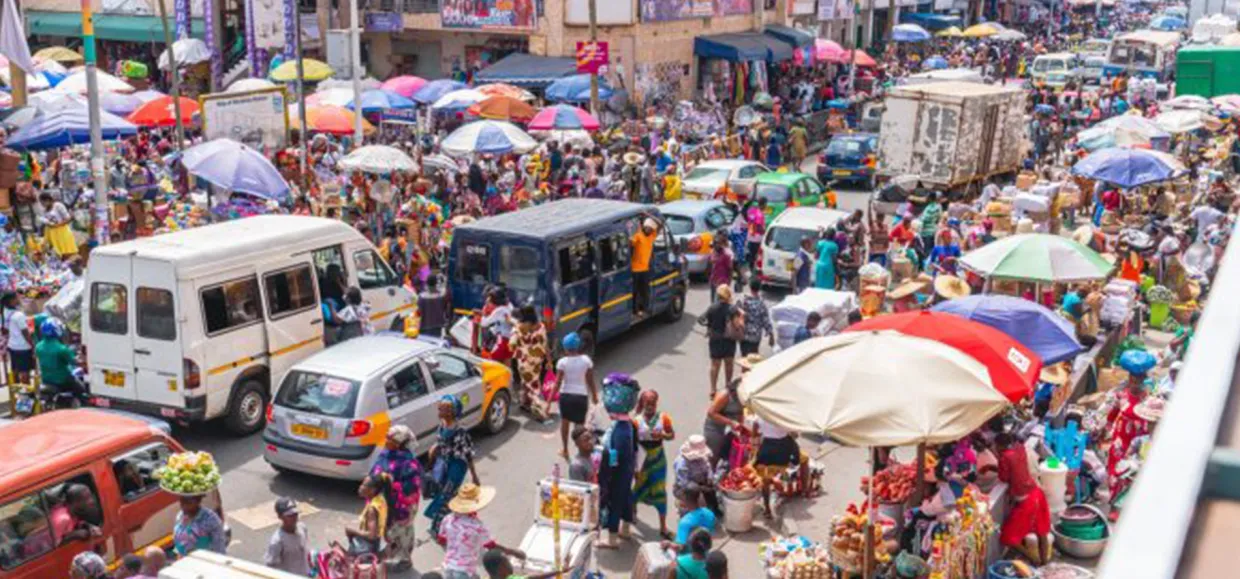
The growth of services reflects Ghana’s increasingly urban and connected economy. It is also the sector where many new jobs are being created, though many of these jobs are informal and may not offer stable incomes.
How Economic Growth Is Reported
The Ghana Statistical Service releases quarterly GDP estimates, usually a few months after the end of each quarter. It also publishes annual GDP figures. The data is typically presented as year-on-year growth rates for total GDP and for each sector.
A year-on-year growth rate compares GDP in a given quarter with GDP in the same quarter a year earlier. This method is preferred because it removes seasonal effects. For example, cocoa production peaks at certain times of the year, and comparing the same quarters avoids distortion.
The quarterly figures can be revised as more data becomes available. Early estimates are often based on partial information and may be adjusted later.
What GDP Growth Does and Does Not Tell You
What It Tells You
GDP growth tells you whether the economy is producing more goods and services than it did previously. This matters because increased production often creates jobs, generates income, and expands tax revenue. A growing economy generally has more capacity to support public services, private investment, and household consumption.
GDP also allows international comparisons. It helps the World Bank, IMF, and other institutions classify Ghana as a lower-middle-income country, compare its performance with peers, and make lending and policy decisions.
What It Does Not Tell You
GDP does not tell you how income is distributed. The economy can grow strongly while the benefits flow mainly to a small number of people. A mining boom, for example, can raise GDP significantly while leaving many communities unaffected or even harmed.
GDP does not measure quality of life directly. It does not capture leisure time, environmental quality, health, or happiness. A country can increase GDP by cutting down forests or extracting resources, but that may reduce the well-being of future generations.
GDP does not count unpaid work. In Ghana, many people — especially women — perform essential work that is not paid: caring for children and the elderly, preparing meals, managing households, and supporting family farms. None of this appears in GDP, even though it sustains the economy.
GDP does not capture the informal economy fully. Although the Ghana Statistical Service makes efforts to estimate informal activity, some portion inevitably goes unrecorded. This means official GDP may understate the true level of economic activity.
GDP also says nothing about stability. A country can have high growth one year and a sharp contraction the next. Growth that is volatile creates uncertainty and is less valuable than stable, sustained growth.
Why GDP Growth Can Coexist with Hardship
One of the most confusing experiences for ordinary Ghanaians is hearing that the economy is growing while their own circumstances are deteriorating. This is not a contradiction. It is a reflection of what GDP measures and what it ignores.
Consider an economy where the mining sector expands rapidly. Gold production rises, exports increase, and GDP grows. But mining is capital-intensive, meaning it employs relatively few people compared with the value it produces. The surrounding communities may see little benefit. Meanwhile, food prices may be rising, eroding the purchasing power of households. GDP growth and household hardship can occur simultaneously.
Similarly, if government spending on large infrastructure projects drives growth, the benefits may take years to reach ordinary citizens. The workers on those projects earn income, and the government reports higher GDP, but a market woman in a different region may feel no improvement.
It is also possible for GDP to grow while wages stagnate. If businesses increase output by using more machinery or by intensifying the work of existing staff, productivity rises but workers may not share in the gains. Profits rise, GDP rises, but pay cheques do not.
This is why economists and development experts often supplement GDP with other indicators, such as household income surveys, employment data, poverty rates, and measures of inequality.
Ghana’s GDP in Context
Ghana’s GDP has grown substantially over the past three decades, transforming the country from a low-income to a lower-middle-income economy. But growth has been uneven. There have been periods of rapid expansion, driven in part by the start of oil production and strong commodity prices, and periods of slowdown linked to power shortages, fiscal problems, and global shocks.
The structure of the economy has shifted. Services now contribute the largest share of GDP, followed by industry and then agriculture. This structural change reflects urbanisation, the growth of communications and finance, and the relative decline of agriculture in output terms, even as farming remains a key employer.
The oil and gas sector presents a special case. When production began in 2010, it added a new source of export revenue and government income. It also made GDP figures more sensitive to global oil prices. When oil prices are high, the industry sector and government revenue rise. When prices fall, both are affected. The non-oil economy, however, is a better reflection of what is happening for most Ghanaians, because oil production employs relatively few people directly.
The Ghana Statistical Service now publishes both overall GDP growth and non-oil GDP growth precisely because the two can diverge significantly. A year in which oil production booms may show strong overall growth even if the rest of the economy is sluggish.
Common Misconceptions
“GDP measures how rich the country is”
GDP measures economic output, not wealth. A country with high GDP may have large debts, depleted natural resources, or severe inequality. Wealth, in the sense of assets accumulated over time, is different from income generated in a single year.
“If GDP is growing, everyone is better off”
As explained earlier, growth does not guarantee broad improvement. The gains from growth can be unevenly distributed. Some people may be worse off even as average output rises.
“A rise in GDP is the same as development”
Development is a broader concept than economic growth. It includes improvements in health, education, security, environmental sustainability, and opportunity. GDP can rise while these dimensions stagnate or decline.
“GDP includes everything of value”
GDP excludes many things of value, including unpaid care work, informal activities that are not captured, environmental services, and non-market activities. It also fails to subtract some harmful activities. For example, pollution that causes illness may increase spending on healthcare, which adds to GDP, even though the underlying situation is worse.
“Ghana’s GDP growth means the government has more money”
GDP growth and government revenue are related but distinct. Government revenue depends on tax collection, which is influenced by tax rates, compliance, and the structure of the economy. A sector can grow rapidly while contributing little to government revenue, especially if it enjoys tax exemptions or operates informally.
Frequently Asked Questions
Who calculates Ghana’s GDP?
The Ghana Statistical Service is the official institution responsible for calculating and publishing GDP data. It follows international standards and works with other agencies, such as the Bank of Ghana and the Ministry of Finance, on some underlying data.
What is the difference between GDP and GNI?
GDP measures production within Ghana’s borders, regardless of who owns the production. Gross National Income, or GNI, measures income earned by Ghanaians, wherever they are, minus income sent abroad by foreigners. If foreign companies in Ghana send large profits home, GNI can be lower than GDP.
Why do GDP figures get revised?
GDP estimates are based on data collected from surveys, administrative records, and company reports. Initial estimates may rely on incomplete data. As more information becomes available, the Ghana Statistical Service revises its figures to improve accuracy.
Does GDP measure the informal economy?
The Ghana Statistical Service makes efforts to estimate informal sector activity, but measuring it precisely is difficult. Informal businesses may not keep records, and many transactions go unreported. This means official GDP may understate total economic activity.
Why does agriculture have a small share of GDP but employ so many people?
Agriculture’s share of GDP reflects the monetary value of its output, not the number of people involved. Many smallholder farmers produce relatively low-value output while working with limited technology and inputs. Services and industry can generate high value with fewer workers. This is why employment and output figures can tell different stories.
What is non-oil GDP?
Non-oil GDP is total GDP excluding oil and gas production. It is useful because oil production can be volatile and capital-intensive, and changes in oil output may not reflect conditions in the broader economy. The Ghana Statistical Service reports non-oil GDP growth alongside total GDP growth.
How does GDP affect my daily life?
GDP influences government policy, interest rates, investment, and international perceptions of Ghana. A growing economy may create more jobs and income over time, but the effect on any individual depends on how growth is distributed. GDP itself is a national measure, not a personal one.
Why Understanding GDP Matters
GDP is not just a number for economists and politicians. It shapes the decisions that affect your life. When GDP growth is strong, the government may have more confidence to spend on roads, schools, and hospitals. When growth is weak, cuts may follow. When the World Bank or IMF assesses Ghana, they look at GDP figures. When investors decide whether to put money into the country, they examine GDP trends.
But GDP is not destiny. It is a tool — and like any tool, it has limits. Understanding those limits makes you a more informed citizen. You can appreciate what growth means without being fooled into thinking it solves every problem. You can ask better questions: growth for whom? Growth from what? Growth at what cost?
The next time a news report announces that Ghana’s economy has grown, you will know what to make of it. You will know that the figure represents the total value of goods and services produced, adjusted for inflation. You will know that it captures some things and misses others. And you will know that the real test is not just whether the economy is growing, but whether that growth translates into better lives for ordinary Ghanaians.
That is the question GDP cannot answer on its own.
Source: The Accra Daily Mail

Samuel Kwame Boadu is a Ghanaian media entrepreneur and storyteller with a passion for amplifying urban voices and uncovering everyday truths. He is the Editor-in-Chief and Founder of The Accra Daily Mail, a dynamic digital platform dedicated to capturing the pulse of Ghana’s capital—its people, culture, challenges, business, sports and innovations.