







Ghana’s constitutional history is a story of ambition, interruption and recovery. Since independence in 1957, the country has lived under four republican constitutions, experienced three military coups, and navigated periods of both authoritarian rule and democratic consolidation. The document that governs Ghana today — the 1992 Constitution — was born out of a specific historical moment and has proven remarkably durable, surviving seven election cycles and multiple peaceful transfers of power.
But it has not been static. The Constitution has been amended, reviewed and debated. Understanding how it has changed — and why — explains much about how Ghana’s democracy works today.
Quick Facts
-
First Constitution: The 1957 Constitution established Ghana as a constitutional monarchy within the Commonwealth, with Queen Elizabeth II as Head of State.
-
First Republic: The 1960 Constitution made Ghana a republic with Kwame Nkrumah as President. It was replaced after the 1966 coup.
-
Second and Third Republics: The 1969 Constitution established the Second Republic; the 1979 Constitution established the Third Republic. Both were short-lived.
-
Fourth Republic: The 1992 Constitution was approved by referendum on 28 April 1992 and entered into force on 7 January 1993 .
-
Amendments: The 1992 Constitution has been amended, most notably by Act 527 of 1996 . A major review process was initiated in 2010.
-
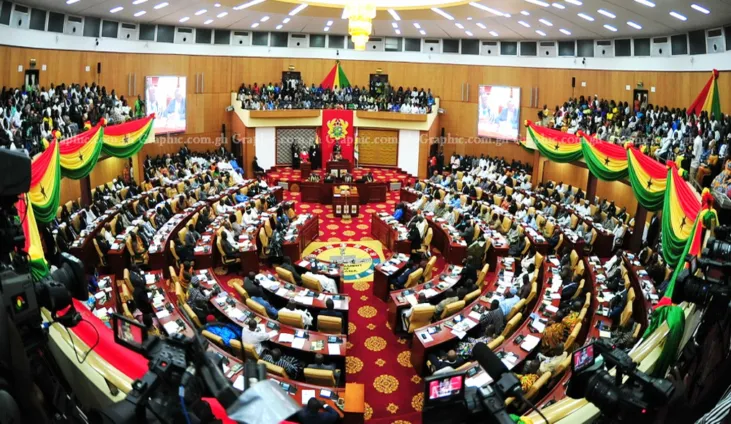
Current framework: The Constitution establishes a unitary, republican, presidential system with a unicameral Parliament and an independent judiciary .
Before 1957: The Colonial Constitutional Legacy
Ghana’s constitutional journey did not begin at independence. The Gold Coast Colony went through a series of constitutional reforms under British rule, each expanding African representation in the Legislative Council. The 1946 Burns Constitution, the 1951 Coussey Constitution and the 1954 Constitution progressively moved the territory toward self-government.
These colonial constitutions established the institutional habits — legislative councils, ministerial systems, judicial structures — that would shape post-independence arrangements. But they were designed for colonial administration, not sovereign statehood.

The 1957 Constitution: Independence and Constitutional Monarchy
On 6 March 1957, Ghana became the first sub-Saharan African country to gain independence from colonial rule . The 1957 Constitution established a constitutional monarchy. Queen Elizabeth II remained Head of State, represented in Ghana by a Governor-General. Kwame Nkrumah served as Prime Minister.
This arrangement lasted only three years. In 1960, Ghana held a plebiscite and became a republic .
The 1960 Constitution: The First Republic
The 1960 Constitution created the First Republic. It replaced the Governor-General with a President who was both Head of State and Head of Government. Kwame Nkrumah was elected the first President .

The 1960 Constitution concentrated significant power in the presidency. It was a presidential system, but one that increasingly tilted toward authoritarianism. In 1964, Ghana became a one-party state following a constitutional amendment . Nkrumah’s government argued that this was necessary for national unity and development. Critics saw it as the death of constitutional governance.
The 1960 Constitution was a product of its time — a document designed to consolidate a newly independent nation, but one that failed to prevent the slide into dictatorship. The Supreme Court, under this Constitution, was notably weak. In a landmark case, the Court held that it lacked the power to declare a law unconstitutional under the 1960 Constitution . This judicial restraint — or inability — would have consequences.
The 1966 Coup and the Long Interregnum
On 24 February 1966, while Nkrumah was on a state visit abroad, the military and police overthrew his government . The National Liberation Council (NLC) suspended the 1960 Constitution and ruled by decree.

This began a period of constitutional uncertainty. Between 1966 and 1979, Ghana alternated between military rule and brief civilian experiments. The 1969 Constitution established the Second Republic under Prime Minister Kofi Busia, but it lasted only until January 1972, when Colonel Ignatius Acheampong seized power . The 1979 Constitution established the Third Republic under President Hilla Limann, but it too was cut short — in December 1981, Flight Lieutenant Jerry Rawlings overthrew Limann in a coup .
The lesson from this period was clear: constitutions alone could not guarantee democratic stability. The political culture, the commitment of elites, and the institutional strength of countervailing powers mattered just as much.
The 1992 Constitution: A New Beginning
The Provisional National Defence Council (PNDC), led by Rawlings, governed from 1982 until 1992. Under pressure to return to democratic rule, the PNDC established a Consultative Assembly to draft a new constitution.
The draft was subjected to a referendum on 9 April 1992. The people approved it, with the condition that it would come into force on 7 January 1993 . Elections were held in December 1992, and Rawlings was elected President. The Fourth Republic began.
The 1992 Constitution was designed to prevent the abuses of the past. It established a presidential system, but one with stronger checks and balances than the 1960 Constitution. It created independent institutions — the Electoral Commission, the National Media Commission, the Commission on Human Rights and Administrative Justice — designed to safeguard democratic governance . It guaranteed fundamental rights and freedoms, including freedom of expression, assembly and association .
Crucially, it gave the Supreme Court a clear role as the guardian of constitutionalism. Unlike the 1960 Constitution, the 1992 document expressly empowered the Court to declare laws unconstitutional. The Supreme Court has repeatedly asserted its authority to determine what the Constitution means and to enforce its provisions .
The 1996 Amendment: The First Change
The 1992 Constitution has been amended. The most significant amendment came in 1996, through Act 527 . This amendment made adjustments to the Constitution, though the details are not extensively documented in available public sources.
The Constitution Review Commission, in its 2011 report, noted that although the 1992 Constitution had been amended once in a limited way, that amendment process was not preceded by a review exercise . This observation underscored a concern: the Constitution was being changed without systematic assessment of its overall operation.
The 2010-2012 Review: A Comprehensive Assessment
The most ambitious attempt to reform the 1992 Constitution came in 2010. President John Evans Atta Mills, acting under Article 289 of the Constitution, established a ten-member Constitution Review Commission (CRC) . Its mandate was to consult Ghanaians on the strengths and weaknesses of the 1992 Constitution and recommend amendments.
The CRC conducted extensive public consultations across the country. Its December 2011 report, titled “From a Political to a Developmental Constitution,” made recommendations on a wide range of issues . Among the proposals was the abolition of the death penalty, replaced by life imprisonment without parole .
The government issued a White Paper in June 2012 largely accepting the CRC’s recommendations . A five-member Constitution Review and Implementation Committee (CRIC) was then established to draft amendment bills for Parliament.
But the process stalled. A legal challenge — Professor Stephen Kwaku Asare v Attorney-General — questioned whether the President had the constitutional authority to initiate the review process, arguing that Parliament’s power to amend the Constitution was plenary and exclusive . The Supreme Court, by a five-to-two majority, held that the President had acted within his powers and that the review process was not unconstitutional . Yet despite this legal validation, the substantive amendments recommended by the CRC have not been fully implemented.
The 2025 Amendment Bill: Dual Citizenship and Public Office
The most recent constitutional amendment effort concerns dual citizenship. A Bill introduced in Parliament seeks to amend Article 94(2)(a), which disqualifies persons with dual citizenship from holding certain public offices .
The Bill was first introduced in the Eighth Parliament in 2021, passed through Second Reading in July 2024, but lapsed when Parliament dissolved in January 2025. The Ninth Parliament revived it, and it was co-sponsored by four MPs .
The Council of State advised against passage, citing concerns about national security, divided loyalty and institutional accountability. Speaker Alban Bagbin disclosed the Council’s opposition in a statement to Parliament, noting that the advice is not binding but raises significant constitutional questions. He referred the Bill to the Constitutional and Legal Affairs Committee for consideration .
This ongoing debate illustrates a key feature of Ghana’s constitutional system: even when there is political will to amend, the process is deliberately difficult. Article 291 of the Constitution requires that amendments to entrenched provisions be referred to the Council of State for advice before Parliament can proceed . This creates a consultative barrier designed to prevent hasty or partisan changes.
How the Constitution Can Be Changed
The 1992 Constitution distinguishes between entrenched and non-entrenched provisions.
Amendments to non-entrenched articles require passage by Parliament and presidential assent. Amendments to entrenched articles — which include provisions on national sovereignty, fundamental rights and freedoms, the structure and authorities of the branches of government, and the amendment procedure itself — require a more demanding process .
For entrenched provisions, the Constitution requires approval in a referendum by at least 40% of eligible voters, with at least 75% of votes cast in favour. This must be followed by a two-thirds majority vote in Parliament and presidential assent . This is a deliberately high threshold, designed to ensure that fundamental constitutional changes reflect broad national consensus, not narrow political advantage.
Why the 1992 Constitution Has Endured
The 1992 Constitution is now in its fourth decade. It has survived seven general elections, multiple peaceful transfers of power between rival political parties, and various political crises. Why has it lasted when previous constitutions did not?
Part of the answer lies in its design. The independent institutions it created — particularly the Electoral Commission — have played a critical role in managing elections credibly. The Supreme Court has asserted its authority as a check on executive power . The Constitution’s guarantees of civil and political liberties have created space for civil society, media and opposition parties to operate .
Another part of the answer lies in political culture. Ghana’s political elites, whatever their differences, have largely accepted the Constitution as the framework for resolving disputes. When the 2012 election was challenged, the opposition took its case to the Supreme Court rather than to the streets. That decision — to work within the constitutional system — is itself a form of constitutionalism.
The 1992 Constitution is not perfect. The CRC’s review identified weaknesses. Debates over executive power, decentralisation and the role of the Council of State continue. But the Constitution has proven adaptable enough to accommodate these debates without breaking.
Frequently Asked Questions
How many constitutions has Ghana had?
Ghana has had several constitutions. The key ones are the 1957 independence Constitution, the 1960 First Republic Constitution, the 1969 Second Republic Constitution, the 1979 Third Republic Constitution, and the 1992 Constitution that established the Fourth Republic .
When did the 1992 Constitution come into force?
It was approved by referendum on 28 April 1992 and entered into force on 7 January 1993 .
Has the 1992 Constitution been amended?
Yes. It was amended by Act 527 of 1996 . A comprehensive review process was initiated in 2010, but many of the recommended amendments have not been implemented.
What is the process for amending the Constitution?
For non-entrenched provisions, Parliament passes an amendment bill and the President assents. For entrenched provisions, a referendum is required with at least 40% voter turnout and 75% approval, followed by a two-thirds parliamentary majority and presidential assent .
What was the Constitution Review Commission?
The CRC was established in 2010 by President Mills to consult Ghanaians on the operation of the 1992 Constitution and recommend changes. Its 2011 report proposed numerous amendments, including abolishing the death penalty .
Why did the 1960 Constitution fail?
The 1960 Constitution concentrated power in the presidency and was amended to create a one-party state in 1964. It was overthrown by a military coup in 1966 . The failure was as much political as constitutional — the document itself could not prevent the erosion of democratic governance.
What is the current debate about dual citizenship?
A Bill before Parliament seeks to amend Article 94(2)(a), which disqualifies dual citizens from certain public offices. The Council of State has advised against passage, and the Bill is under committee consideration .
Why does the 1992 Constitution require a referendum for entrenched provisions?
The referendum requirement ensures that fundamental constitutional changes reflect broad popular consent, not just parliamentary majorities. It is a safeguard against hasty or partisan amendments to the Constitution’s core architecture .
What to Remember
Ghana’s constitutional history reflects the country’s broader political journey: from colonial rule to independence, from democratic aspiration to authoritarian interruption, and from military rule to a durable Fourth Republic.
The 1992 Constitution was designed to learn from the failures of its predecessors. It strengthened the judiciary, created independent institutions, and made amendments deliberately difficult. It has endured because political actors have largely chosen to work within it, even when it constrains their power.
But the Constitution is not frozen. It has been amended, reviewed and debated. The current dual citizenship amendment effort shows that the process of constitutional change continues. The high thresholds for amendment — particularly the referendum requirement for entrenched provisions — mean that change requires broad consensus. That is a feature, not a bug.
For ordinary Ghanaians, the Constitution is not an abstract document. It determines how power is exercised, how rights are protected, and how disputes are resolved. Understanding its history and its amendment process is part of understanding how Ghana is governed.
Source: The Accra Daily Mail

Samuel Kwame Boadu is a Ghanaian media entrepreneur and storyteller with a passion for amplifying urban voices and uncovering everyday truths. He is the Editor-in-Chief and Founder of The Accra Daily Mail, a dynamic digital platform dedicated to capturing the pulse of Ghana’s capital—its people, culture, challenges, business, sports and innovations.