



When you interact with government at the local level, you are dealing with a system that has two distinct tiers: the region and the district. The regional tier coordinates. The district tier governs. Understanding the difference between them – and how they relate to each other and to Accra – explains a lot about why local development happens the way it does.
Ghana has 16 regions and 261 Metropolitan, Municipal and District Assemblies (MMDAs). The regional tier is led by a Regional Minister and a Regional Coordinating Council (RCC). The district tier is led by an MMDA, headed by a Chief Executive appointed by the President. Both tiers are part of Ghana’s decentralisation architecture, but they have very different mandates and very different relationships with central government.
Quick Facts
-
16 regions, 261 districts: Ghana’s local governance structure comprises 16 regional coordinating councils and 261 MMDAs .
-
RCC composition: Chaired by the Regional Minister, the RCC includes the Deputy Regional Minister, the Regional Coordinating Director, District Chief Executives, and elected Presiding Members of the districts in the region .
-
MMDA composition: 70% of assembly members are elected on a non-partisan basis; 30% are appointed by the President in consultation with traditional authorities and interest groups .
-
MMDCEs are appointed: Metropolitan, Municipal and District Chief Executives are nominated by the President and confirmed by their Assemblies with a two-thirds majority .
-
Functional departments: MMDAs have 18 devolved service departments, including education, health, agriculture, social welfare, works, and physical planning .
-
Fiscal constraint: Central government transfers make up the vast majority of most district budgets. In the Greater Kumasi sub-region, transfers accounted for 80% to 94% of surrounding districts’ revenues, while Internally Generated Funds (IGF) ranged from 5% to 14% .
The Regional Tier: Coordination, Not Government
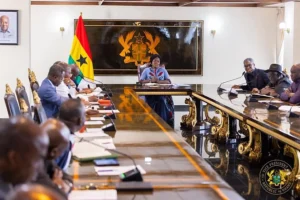
The Regional Coordinating Council is not a government in the way a district assembly is. It does not pass by-laws, does not collect rates, and does not have its own legislative mandate. Its role is to coordinate, monitor and evaluate.
The Western Regional Coordinating Council describes itself as “the highest decision-making body at the regional level, representing the political and administrative machinery of Government”. Its stated mission is to harmonise, coordinate, monitor and evaluate the plans and programmes of Ministries, Departments and Agencies, District Assemblies and NGOs to achieve the overall development of the region.

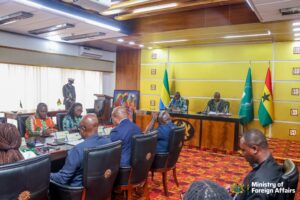
The RCC is chaired by the Regional Minister, a presidential appointee. Its members include the Deputy Regional Minister, the Regional Coordinating Director, the District Chief Executives of the region, and the elected Presiding Members of the district assemblies. Heads of decentralised departments in the region serve as ex-officio members without voting rights.
In practice, the RCC’s most visible role is oversight. Regional Ministers call MMDCEs to order when performance lags. In August 2025, the Greater Accra Regional Minister, Linda Akweley Ocloo, publicly criticised MMDCEs in her region for “inefficiency and complacency,” accusing some of turning their offices into party meeting grounds and relying on personal assistants to carry out official duties. “I will not hesitate to recommend the removal of non-performing chief executives,” she warned.
The RCC also coordinates emergency response. During flooding in Greater Accra in June 2026, the Regional Minister directed all MMDCEs to remain fully engaged in rescue operations and work with NADMO and other agencies. The regional tier steps in when a crisis crosses district boundaries or requires coordination that individual assemblies cannot provide alone.

But the RCC is not a decentralised authority in the full sense. A 2011 Commonwealth profile noted that Regional Ministers chair the RCCs, which comprise representatives from the district assemblies and traditional authorities, but the RCCs themselves are essentially coordinating bodies rather than governments. The Oxford Constitutional Law analysis describes them as “deconcentration” rather than decentralisation – the President retains overriding authority over regional matters, and the RCC’s deliberations carry little weight against presidential authority.
The District Tier: Where Local Government Actually Happens
The Metropolitan, Municipal and District Assemblies are the real units of local government. They are established by legislative instruments, have corporate status, and are responsible for the overall development of their territories.
The distinction between Metropolitan, Municipal and District Assemblies is based on population and settlement pattern. Metropolitan Assemblies cover urban areas with populations above 250,000. Municipal Assemblies cover single towns with populations of 95,000 and above. District Assemblies cover wider areas combining rural settlements and small towns . Despite these differences, all MMDAs share the same internal structure.

Composition and leadership. Each MMDA is composed of 70% elected members, elected on a non-partisan basis, and 30% appointed by the President in consultation with traditional authorities and other interest groups . Members of Parliament whose constituencies fall within the district are ex-officio members without voting rights. The Assembly is presided over by a Presiding Member elected from among the members.
The executive head is the Metropolitan, Municipal or District Chief Executive (MMDCE), nominated by the President and confirmed by the Assembly with a two-thirds majority of members present and voting, within 21 days of nomination. The MMDCE is the chief representative of the central government in the district and is responsible for the executive and administrative functions of the Assembly.
How the Assembly works. The Assembly operates through an Executive Committee, chaired by the MMDCE, which comprises not more than one-third of all Assembly members. Below the Executive Committee are mandatory sub-committees: Development Planning, Social Services, Works, Finance and Administration, and Justice and Security. All Assembly members except the Presiding Member must sit on at least one sub-committee.
The sub-committees are deliberative. They examine issues, make recommendations, and submit their findings to the Executive Committee, which in turn reports to the full Assembly. This structure is meant to ensure that decisions are debated and reviewed before they reach the full house.
Devolved departments. The Local Governance Act assigns 18 devolved service sectors to MMDAs, each with a corresponding department. These include Education, Youth and Sports; Health; Agriculture; Physical Planning; Social Welfare and Community Development; Works; Trade and Industry; Roads; Transport; and Waste Management .
These departments are supposed to be under the authority of the Assembly, not their parent ministries in Accra. The composite budgeting system, introduced in the 2012 national budget, was designed to integrate the budgets of these decentralised departments into the Assembly’s budget, ensuring better coordination, ownership, control and accountability. But as the JICA report notes, local autonomy remains “significantly restricted,” with most MMDAs having only a limited size of staff and budget under their power, while decentralised departments have only been given limited budget and accompanying responsibilities from their parent Ministries.
The Sub-District Structures: The Weakest Link
Below the MMDAs sit the sub-district structures: Sub-Metropolitan District Councils in metropolitan areas, and Urban, Zonal, Town and Area Councils, and Unit Committees in other assemblies. These bodies are intended to bring governance closer to communities and provide platforms for local participation.
They do not hold legislative or rating powers . They perform functions delegated to them by the assemblies. Unit Committees, the lowest level, cover populations of less than 1,500 people .
The World Bank has identified the non-functioning of these sub-structures as a significant weakness in Ghana’s local governance. The report notes that the sub-district structures, “intended to provide platforms for local participation,” are not functioning effectively in many areas, and that this compounds concerns about accountability and citizen engagement in local government.
A 2024 study published in Taylor & Francis found that while the majority of Urban, Town and Area Councils were operational, there were significant regional differences, and many operated from temporary office accommodation. The gap between the constitutional vision and the operational reality of these structures remains wide.
The Money Question: Who Pays for Local Government?
Decentralisation without resources is an empty promise. Ghana’s MMDAs have three main funding sources: central government transfers, Internally Generated Funds, and donor support.
Central government transfers are the dominant source for most districts. The District Assemblies Common Fund (DACF) is the largest, constitutionally required to be not less than 5% of national revenue. A District Development Fund (DDF) was created in 2010 to provide additional development financing.
But the amounts are constrained. The JICA report notes that only 7.5% of national income is allocated to DACF, and the total DDF is even smaller. In the Greater Kumasi sub-region, central government transfers accounted for 80% to 94% of the revenues of the six surrounding districts, while Kumasi Metropolitan Assembly was exceptional in generating 19% of its revenue internally.
Internally Generated Funds come from property rates, fees, licences and rents collected by assemblies within their jurisdictions . The capacity to collect IGF varies enormously. KMA’s IGF represented 19% of its total revenue; for surrounding districts, it ranged from 5% to 14% . Regional Ministers have repeatedly urged MMDCEs to enhance IGF to reduce over-dependence on central government grants. The Eastern Regional Minister, Rita Akosua Adjei Awatey, made this point directly to MDCEs in her region in 2025.
Donor support is significant for some assemblies. KMA’s budget was 57% funded by international donors, indicating both dependency on external funding and relatively high fiscal management capacity. For most smaller districts, donor support is negligible.
The composite budget system was meant to improve coordination. But the fundamental fiscal reality remains: most MMDAs depend on Accra for the bulk of their resources. The Greater Accra Regional Minister’s criticism of MMDCEs in 2025 – accusing them of complacency and inefficiency – must be read against this backdrop of constrained resources and limited autonomy .
The Accountability Puzzle: Who Do MMDCEs Answer To?
The most contentious feature of Ghana’s local governance system is the MMDCE appointment process. MMDCEs are not elected by the people. They are nominated by the President and confirmed by the Assembly. This means their primary loyalty is upward, to the President, rather than downward, to local residents.
The World Bank describes this as a “glass half-full” arrangement. The 1992 Constitution provides for assemblies that are 70% elected, but the Presidentially-appointed Chief Executive, whose appointment is subject to Assembly approval, creates a structure where “the extent to which such appointments dilute or compromise downward and local accountability is the subject of considerable political discussion”.
The 2024 inauguration of 259 MMDAs highlighted this tension. President Akufo-Addo, in a speech read on his behalf, called for continuous capacity building and citizen sensitisation, and acknowledged resource constraints. But a sitting MP at the La Nkwantanang-Madina inauguration argued that “selecting the MMDCEs through popular elections would enhance democratic governance and improve accountability at the district level”.
The debate over electing MMDCEs is not new. It has been discussed for years, and the disagreement over whether elections should be partisan or non-partisan has prevented progress. But the underlying question remains: can a system where the executive head is appointed by the President produce the downward accountability that decentralisation promises?
What This Means for Ordinary Ghanaians
The governance of regions and districts determines who makes decisions about local roads, schools, clinics, markets and sanitation. It determines whether your assembly can respond quickly to a flood or a sanitation crisis, or whether it must wait for instructions from Accra.
The structure is clear on paper: RCCs coordinate and monitor; MMDAs govern and deliver services; sub-district structures provide platforms for participation. The reality is more uneven. Regional Ministers exercise oversight but lack independent authority. MMDCEs are accountable upward to the President. Sub-district structures are often non-functional. Fiscal transfers are insufficient and sometimes delayed. IGF capacity varies widely.
For citizens, the practical takeaway is that local government in Ghana is a work in progress. The legal framework exists. The institutions exist. But the power and resources needed to make decentralisation meaningful are still concentrated in Accra. Understanding that gap is the first step toward demanding that it closes.
Frequently Asked Questions
What is the difference between a region and a district in Ghana?
A region is an administrative and coordinating tier led by a Regional Minister and an RCC. A district is the local government tier, led by an MMDA, responsible for local development and service delivery. Ghana has 16 regions and 261 MMDAs.
Who is in charge of a District Assembly?
The Assembly is led by a Presiding Member elected by members. Executive authority is exercised by the MMDCE, who is nominated by the President and confirmed by the Assembly.
What does a Regional Coordinating Council do?
The RCC monitors, coordinates and evaluates the performance of MMDAs and regional departments. It is chaired by the Regional Minister and includes MMDCEs and Presiding Members.
Are MMDCEs elected?
No. MMDCEs are nominated by the President and confirmed by their Assemblies with a two-thirds majority. There are ongoing discussions about moving toward elections .
How are District Assemblies funded?
Through central government transfers (DACF and DDF), Internally Generated Funds from local rates and fees, and donor support. Most districts depend heavily on central transfers .
What are the sub-district structures?
They include Sub-Metropolitan District Councils, Urban, Zonal, Town and Area Councils, and Unit Committees. They perform delegated functions and are meant to provide platforms for local participation, but many are not functioning effectively .
What devolved departments do MMDAs have?
MMDAs have 18 devolved departments, including education, health, agriculture, social welfare, works, physical planning, roads, and waste management .
Why is decentralisation in Ghana considered incomplete?
Because power and resources remain concentrated in Accra. MMDCEs are appointed, not elected. Fiscal transfers are limited. Sub-district structures are weak. Key sectors like education and health remain largely centralised.
What to Remember
Ghana’s regional and district governance system has two tiers with different mandates. The RCC coordinates and monitors. The MMDA governs and delivers services. The structure is built on a clear legal framework: the 1992 Constitution and the Local Governance Act, 2016.
But the system operates under significant constraints. MMDCEs are appointed by the President, not elected by the people. Fiscal transfers are the dominant source of funding for most districts. Sub-district structures are often non-functional. The gap between the constitutional vision of decentralisation and the operational reality remains wide.
For ordinary Ghanaians, the practical question is whether the assembly in your district has the power and resources to solve local problems, or whether it still waits for instructions from Accra. The answer, for now, is somewhere in between.
Source: The Accra Daily Mail

Samuel Kwame Boadu is a Ghanaian media entrepreneur and storyteller with a passion for amplifying urban voices and uncovering everyday truths. He is the Editor-in-Chief and Founder of The Accra Daily Mail, a dynamic digital platform dedicated to capturing the pulse of Ghana’s capital—its people, culture, challenges, business, sports and innovations.