












Quick Facts
-
A week’s food: GH¢500 can cover basic groceries for one person for about a week if you cook at home and buy from markets like Makola or Kaneshie .
-
A month’s transport: After the September 2026 fare increase, GH¢500 covers roughly 45 trotro trips at the GH¢11 fare band .
-
Rent reality: GH¢500 is below the typical monthly rent for even a single room in most of Accra, though shared-facility rooms in areas like Sowutuom have been listed around that price .
-
Inflation context: Ghana’s inflation stood at 5.2% in September 2026, but food inflation was rising again at 4%, and services inflation remained higher at 8.3% .
-
Market prices: A 4.5L bucket of garden eggs cost GH¢98.25, a head of cabbage GH¢20, and four medium tilapia GH¢100 in April 2026 .
The Grocery Basket: What GH¢500 Puts on the Table
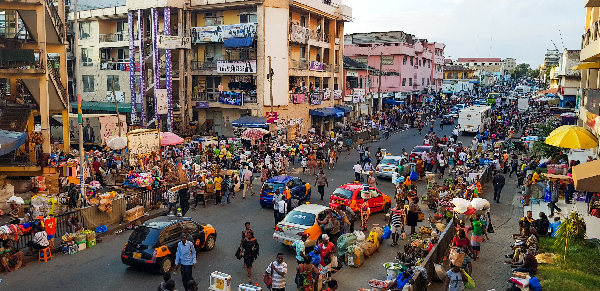
If you walk into Makola or Kaneshie Market with GH¢500 and the intention to cook rather than buy prepared food, you can feed one person for roughly a week. The Accra Street Journal’s budgeting guide recommends buying staples like rice, beans, gari, and oil in bulk, cooking at home, and planning meals weekly to stretch a modest budget .
But the basket is smaller than it would have been a year ago. In April 2026, a 4.5-litre bucket of garden eggs averaged GH¢98.25. A single head of cabbage cost GH¢20. Four medium pieces of tilapia cost GH¢100. A kilogram of beef with bones was GH¢80, and goat meat was GH¢95 . If you buy one protein, one vegetable, and a staple, GH¢500 begins to disappear quickly.
The tomato situation illustrates the volatility. Following a terrorist attack on Ghanaian traders in Burkina Faso in early 2026, a small bowl of tomatoes that previously sold for GH¢5 rose to GH¢20. A medium-sized basket jumped from between GH¢100 and GH¢200 to GH¢600 . Traders switched to sourcing from Togo, but prices remained elevated.
For a household trying to eat balanced meals, GH¢500 is not a month’s food budget. It is a week’s, perhaps ten days at most, if every cedi is spent at the market and nothing is wasted.

The Transport Calculation: How Far GH¢500 Takes You
Transport is the expense that compounds silently. After the 8% fare increase that took effect on 26 September 2026, intra-city trotro fares range from GH¢5.50 to GH¢36.80, depending on distance . A commuter paying GH¢11 each way spends GH¢22 daily. Over a 22-working-day month, that is GH¢484—almost exactly GH¢500.
That means GH¢500 buys a month of commuting for someone whose journey falls in the GH¢11 fare band. But it leaves nothing for food, rent, utilities, or emergencies. And for commuters travelling longer distances, or those who face the informal peak-hour surcharges that push fares above the approved rates, GH¢500 does not cover a month of transport.
The Graphic’s editorial on the fare increase noted that over 80% of urban residents rely on public transport, and that when fares rise, prices rise for everyone else too—the market woman adds transport costs to her tomatoes, the factory worker has less left at month’s end . GH¢500 spent entirely on transport is GH¢500 not spent on anything else.

The Rent Question: The Line GH¢500 Cannot Cross
Housing is where GH¢500 meets its hardest limit. In most of Accra, GH¢500 does not cover a month’s rent for a self-contained room. Property listings reviewed by Yen News in July 2026 found single rooms and self-contained apartments in areas like Ablekuma, Taifa, Lapaz, and Spintex ranging from GH¢600 to GH¢1,000 monthly.
There is one exception. In Sowutuom, ordinary single rooms with shared toilet and bathroom facilities were listed at around GH¢500 monthly . That is the outer edge of what GH¢500 can buy in housing: a room with shared facilities, in a developing area, likely far from the city centre and with transport costs that eat into the savings.
And even that GH¢500 room comes with a catch. Many landlords demand advance rent of one to two years, despite the Rent Act’s six-month cap. A GH¢500 monthly room with a two-year advance requires GH¢12,000 upfront . The monthly figure is almost irrelevant when the lump sum is impossible.

What GH¢500 Does Not Buy
It does not buy a month of modest living. Cost-of-living estimates for Accra place a modest monthly existence—shared accommodation outside prime areas, local food, shared transport—at GH¢4,000 to GH¢8,000. GH¢500 is a fraction of that.
It does not buy a bag of premium imported rice, which cost between GH¢1,445 and GH¢1,511 in early 2026. It does not buy a king-size mattress, priced at GH¢4,990 to GH¢5,540.
It does not buy a month of eating out, even at local chop bars. A plate of jollof or banku with tilapia at a local spot costs GH¢30 to GH¢60. Ten such meals would exhaust GH¢500 entirely .
What GH¢500 Can Actually Do
It can buy a week of home-cooked meals for one person, if you shop at markets, buy staples in bulk, and avoid prepared food .
It can cover a month of trotro commuting for a worker whose daily round trip costs GH¢22 or less .
It can rent a shared-facility room in Sowutuom for one month, if you can find one and negotiate terms that do not require a two-year advance .
It can serve as an emergency buffer—the 20% savings allocation recommended in a GH¢500 budget—that prevents borrowing when a medical need or transport delay arises .
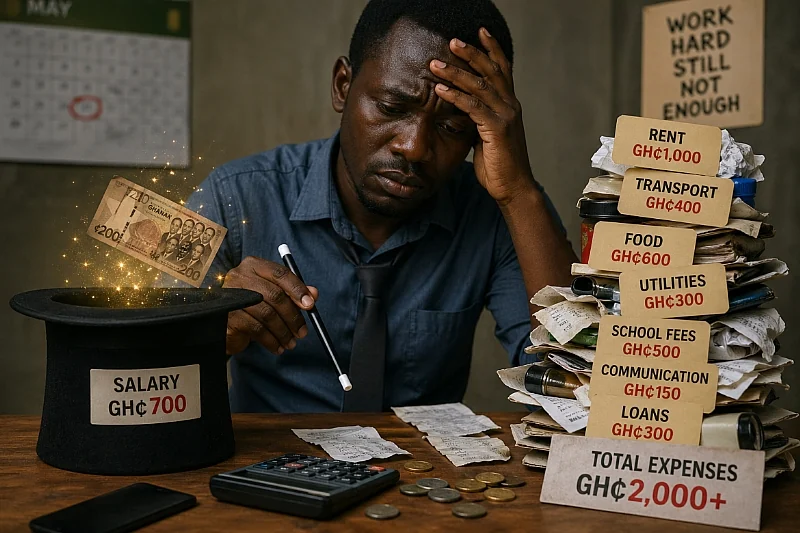
It cannot do all of these things at once. That is the arithmetic of scarcity. GH¢500 is not a monthly budget in Accra. It is a single line item, chosen from a list where every other line also demands payment.
Frequently Asked Questions
Can GH¢500 cover a month’s rent in Accra?
Only in limited cases. Single rooms with shared facilities in areas like Sowutuom have been listed around GH¢500 monthly. Most self-contained rooms and apartments cost GH¢600 to GH¢1,000 or more .
How many days of food does GH¢500 buy?
About one week for one person, if you cook at home and buy staples and vegetables from markets rather than supermarkets or eateries .
How many trotro rides can I take with GH¢500?
At the GH¢11 fare band after the September 2026 increase, roughly 45 one-way trips. That is about a month of commuting for a worker whose daily round trip falls within that band .
Is GH¢500 enough for a month’s living expenses in Accra?
No. Modest monthly living costs are estimated at GH¢4,000 to GH¢8,000. GH¢500 covers only one category of expense—food, transport, or a shared room—not all of them.
What are the cheapest protein options in Accra markets?
Eggs, small fish, and beans are generally cheaper than beef or goat meat. In April 2026, beef was GH¢80/kg and goat meat GH¢95/kg, while four medium tilapia pieces cost GH¢100 .
Why did tomato prices rise so sharply?
A terrorist attack on Ghanaian tomato traders in Burkina Faso disrupted the main supply route. Traders shifted to Togo, and a small bowl that cost GH¢5 rose to GH¢20 .
How has inflation affected what GH¢500 buys?
Inflation was 5.2% in September 2026, but food inflation was rising again at 4%, and services inflation was 8.3%. Prices are rising more slowly than during the crisis, but they have not fallen.
What to Remember
GH¢500 in Accra today is not a monthly budget. It is a choice. It can be a week of food, or a month of transport, or a shared room on the city’s edge. It cannot be all three.
The grocery basket buys less than it did a year ago. The transport fare covers fewer trips. The room with shared facilities is the bottom of the housing market, and even that requires a lump sum most earners cannot produce.
For anyone trying to stretch GH¢500, the practical strategies are the same ones the Accra Street Journal recommends: cook at home, buy from markets, use trotros, track spending, and keep a small buffer for emergencies. But strategy has limits. When the arithmetic does not add up, no amount of discipline can change the sum.
Source: The Accra Daily Mail

Samuel Kwame Boadu is a Ghanaian media entrepreneur and storyteller with a passion for amplifying urban voices and uncovering everyday truths. He is the Editor-in-Chief and Founder of The Accra Daily Mail, a dynamic digital platform dedicated to capturing the pulse of Ghana’s capital—its people, culture, challenges, business, sports and innovations.