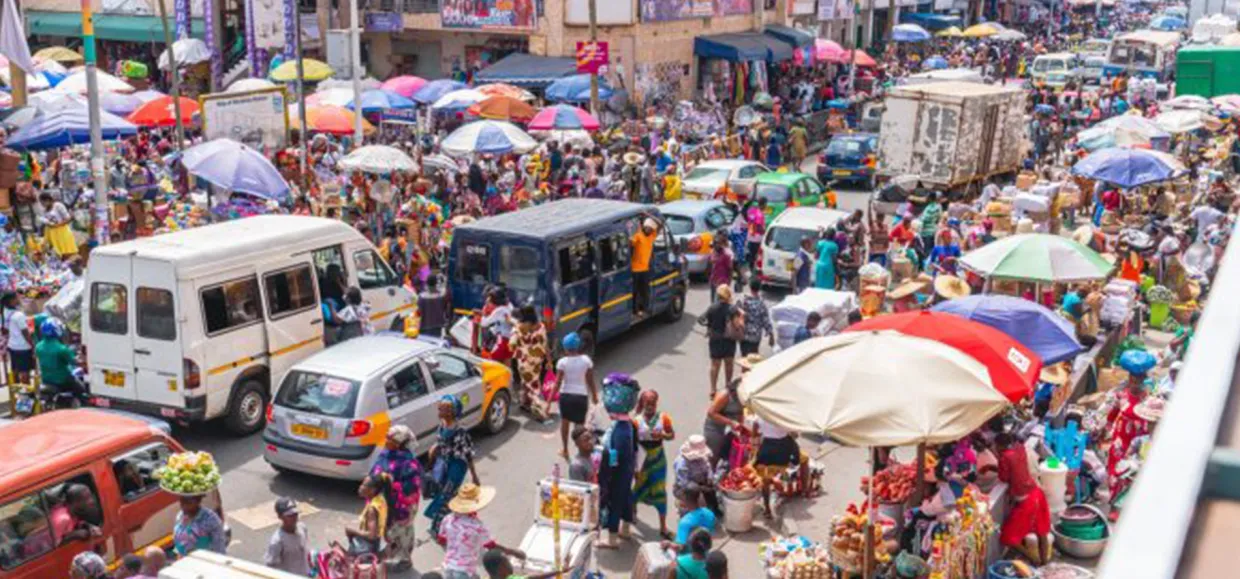


Ghana’s economy is often described in terms that miss most of what actually happens in it. The formal sector — banks, mines, factories, government offices — dominates the headlines and the official data. But the lives of most Ghanaians are shaped by a different economy, one that operates largely outside the formal system and outside the statistics that are supposed to measure it.
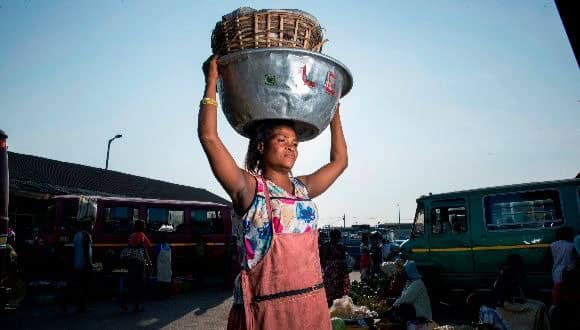
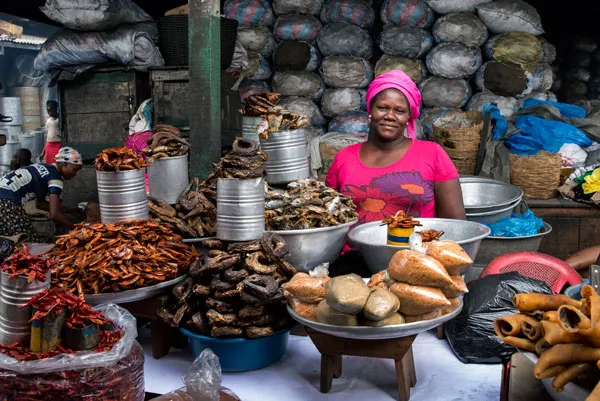
This is the informal economy. It includes the market trader who sells tomatoes from a wooden table, the seamstress who works from a shop attached to her home, the mobile money agent on the corner, the commercial driver, the food vendor, the carpenter. These workers are not a small minority. They are the majority. And understanding how this vast, largely invisible economy works is essential to understanding Ghana itself.
Quick Facts
-
According to the Ghana Statistical Service, nearly 80% of Ghana’s workforce is employed in the informal sector .
-
Despite employing the vast majority of workers, the informal sector contributes only about 27% of Ghana’s GDP .
-
The 2021 Population and Housing Census recorded that 79.7% of employed Ghanaians worked in the private informal sector .
-
Informal businesses are concentrated in trade, agriculture, repair services, and light manufacturing.
-
Most informal enterprises are not registered with the Registrar General’s Department and do not pay formal income tax.
-
Mobile money has become a critical financial tool for informal workers, providing access to payments and savings outside the formal banking system .
-
The Ghana Revenue Authority has introduced a Modified Taxation Scheme to bring informal workers into the tax net with simplified, flat-rate payments .
What the Informal Economy Is
The informal economy refers to economic activity that is not regulated, registered, or taxed by the state. In Ghana, this includes a vast range of livelihoods.
The common features are:
-
No formal registration with the Registrar General’s Department
-
No formal employment contract or social protection
-
Income is often irregular and cash-based
-
No formal business records or accounts
-
No contribution to formal social security schemes
The informal sector is not a single thing. It includes self-employed traders, artisans, transport operators, small farmers, and a range of service providers. It also includes wage workers employed by informal enterprises, often without contracts or benefits.
The Ghana Statistical Service defines the informal sector as comprising private unincorporated enterprises owned by households. These enterprises may be engaged in agriculture or non-agricultural activities, and they may employ a few workers or none at all.
The Scale of the Informal Economy
The numbers are striking. The 2021 Population and Housing Census found that 79.7% of employed Ghanaians worked in the private informal sector . This is consistent with earlier surveys, which have consistently shown the informal sector dominating employment.
The Ghana Living Standards Survey, conducted periodically by the Ghana Statistical Service, has documented the same pattern. Household surveys have found that the vast majority of households derive at least some income from informal activities, and that informal income accounts for the majority of total household income .
This is not a new phenomenon. The informal sector has dominated Ghana’s labour market for decades. Despite economic growth and the expansion of the formal sector, the share of employment in the informal economy has remained stubbornly high. The Ghana Statistical Service has noted that informal employment has remained highly pervasive, with no substantial reduction over the past decades .
The Productivity Gap
One of the most important findings in recent years is the productivity gap between the informal and formal sectors. While the informal sector employs nearly 80% of the workforce, it contributes only about 27% of GDP .
This gap reflects the low productivity of most informal work. The reasons are structural:
-
Limited access to capital and technology
-
Small scale of operations
-
Low levels of education and training
-
Poor infrastructure
-
Lack of formal business systems
The productivity gap matters because it means that most workers are concentrated in activities that generate relatively little value. The formal sector — mining, finance, telecommunications, large-scale manufacturing — generates far more output per worker.
The Ghana Statistical Service has noted that labour productivity gains between 1991 and 2019 were concentrated in capital-intensive sectors such as mining and finance, while the informal sector lagged behind .
What Informal Work Looks Like
The informal economy is not monolithic. It includes a wide range of activities, from subsistence-level survival work to fairly profitable enterprises.
Self-Employment
Most informal workers are self-employed. They run their own enterprises, often alone or with family members. The Ghana Living Standards Survey has found that self-employment accounts for the majority of informal sector income .
Self-employed informal workers include market traders, street vendors, artisans, repairers, taxi and trotro drivers, hairdressers, tailors, and small-scale farmers.
Informal Wage Employment
Some informal workers are employed by others — by informal enterprises or by households. These workers often lack contracts, social protection, and job security. Research has found that informal wage employment is divided between higher-paid and lower-paid segments, and that many informal wage workers are involuntarily in the sector, meaning they would prefer formal employment if they could get it .
Agriculture
A significant portion of informal sector activity is agricultural. Smallholder farmers operate outside formal structures, selling produce in local markets and to informal traders. Agricultural income has historically been a major component of informal sector income .
Why the Informal Sector Exists
The informal sector is not simply a matter of choice. For many Ghanaians, it is the only option.
Limited Formal Employment
The formal sector cannot absorb the millions of young people entering the labour market each year. The public sector is not expanding significantly, and formal private sector employment remains limited. The informal sector absorbs the surplus.
Barriers to Formalisation
Starting a formal business requires registration, tax compliance, and adherence to regulations. These requirements are manageable for some but create barriers for others. The costs and complexity of formalisation can discourage small operators from entering the formal system.
Flexibility and Autonomy
Some informal workers choose the sector because it offers flexibility and autonomy. A market trader can set her own hours and make her own decisions. A driver can work when he wants. For some, the independence of informal work is preferable to the constraints of formal employment.
The Nature of the Economy
Ghana’s economy is structured in a way that produces informality. The formal sector is capital-intensive and generates relatively few jobs. The informal sector is labour-intensive and absorbs the workforce. This is not a temporary condition; it is a structural feature of the economy.
How Informal Businesses Operate
Informal businesses operate by different rules than formal ones.
Finance
Access to finance is a major challenge. Banks are reluctant to lend to informal businesses because they lack collateral, credit history, and formal records. Informal operators rely on personal savings, family support, and informal credit arrangements.
Mobile money has become a critical financial tool. It provides a safe place to store money, a way to send and receive payments, and a record of transactions that can be used to demonstrate creditworthiness. The Bank of Ghana has noted that mobile money has been “the single most transformative tool of financial inclusion in Ghana” .
Records
Most informal businesses do not keep formal records. Accounts are often kept in the owner’s head or in a notebook. This makes it difficult to calculate profit, manage cash flow, or access formal finance.
Regulation
Informal businesses operate largely outside the regulatory system. They may not have business licences, may not pay formal taxes, and may not comply with all applicable regulations. This is not necessarily a deliberate choice; it often reflects the complexity and cost of formal compliance.
The Tax Challenge
The informal sector presents a major challenge for tax collection. The Ghana Revenue Authority has found it difficult to tax the incomes of the roughly 7.7 million Ghanaians working in the informal sector, compared with the 2.3 million formal sector workers who pay personal income tax automatically through payroll .
The government has introduced measures to bring informal workers into the tax net. The Modified Taxation Scheme, launched in late 2025, offers a simplified tax system for informal sector workers and small businesses. Under the scheme, individuals and enterprises with income not exceeding GH¢500,000 can pay a flat rate of 3% .
The scheme is designed to replace complex assessments with a “pay-as-you-go” digital approach, making tax payment as simple as a money transfer. The GRA estimates that the potential population in this segment is about 8 million people .
Financial Inclusion
Financial inclusion has expanded significantly in Ghana, largely driven by mobile money. The Bank of Ghana has reported that the financial inclusion rate has reached 81%, with registered mobile money accounts rising to 83 million and an agent network of approximately 992,000 points nationwide .
However, the headline figure masks a persistent rural gap. Inclusion rates in urban centres exceed 75%, while in rural regions — particularly the Northern, Upper East, and Upper West regions — rates remain below 50% .
The Bank of Ghana has signalled a shift from focusing on access alone to focusing on impact — ensuring that financial services are actively used to improve livelihoods and support businesses. Digital footprints from mobile money transactions are increasingly being used to assess creditworthiness, opening new opportunities for informal workers who lack traditional documentation .
Banks have also introduced products targeted at informal businesses. GCB Bank, for example, has launched group loans for micro and small enterprises, allowing groups of up to ten traders to access up to GH¢200,000 at 3% monthly interest .
The Social Dimension
The informal sector is not just an economic category. It is a social world.
Informal workers often lack social protection. They do not have employer-provided pensions, paid leave, or health insurance through formal employment. The National Health Insurance Scheme provides some coverage, but it is not a substitute for comprehensive social protection.
Informal work is also gendered. Women are disproportionately represented in the informal sector, particularly in trade and agriculture. Research has found that women have significantly less access to wage employment, both formal and informal, and are more likely to be in lower-paid informal self-employment .
The poverty rates among informal workers are higher than among formal workers. Households dependent on informal income are more likely to be poor, and informal wage workers and unpaid family workers face particularly high poverty rates .
Common Misconceptions
“The informal sector is just a temporary stage of development”
The informal sector has persisted for decades and has not shrunk as the economy has grown. It is a structural feature of Ghana’s economy, not a transitional phase.
“Informal workers don’t pay any taxes”
Informal workers pay indirect taxes — VAT on goods they buy, import duties on goods they consume, and local levies. They may also pay some direct charges. The challenge is collecting income tax from them, not that they pay nothing.
“Informal businesses are all small and unproductive”
While most informal businesses are small, some are quite substantial. The informal sector includes traders with significant capital, transport operators with multiple vehicles, and artisans with valuable skills.
“Formalising the informal sector would solve the problem”
Formalisation brings benefits, but it also imposes costs. For many informal operators, the costs of formalisation outweigh the benefits. The solution is to make formalisation more attractive and less burdensome.
“Mobile money has solved financial inclusion”
Mobile money has expanded access significantly, but gaps remain, particularly in rural areas and among older and lower-income populations. Access to a mobile money account is not the same as meaningful financial inclusion.
Frequently Asked Questions
What percentage of Ghana’s workforce is in the informal sector?
According to the Ghana Statistical Service, nearly 80% of the workforce is employed in the informal sector .
Why does the informal sector contribute so little to GDP?
The informal sector is characterised by low productivity, small scale, limited access to capital and technology, and low levels of formal education and training. These factors limit the value generated per worker.
Do informal workers pay taxes?
Informal workers pay indirect taxes through their consumption. The challenge is collecting income tax from them. The GRA has introduced a simplified tax scheme to encourage compliance .
How can I access credit as an informal business?
Mobile money transaction records can help demonstrate creditworthiness. Some banks offer group loans to informal traders. Microfinance institutions and fintech lenders also serve the informal sector.
Is the informal sector growing or shrinking?
The informal sector has remained persistently large, despite economic growth. The share of informal employment has not declined substantially over the past decades .
What is the Modified Taxation Scheme?
It is a simplified tax system introduced by the Ghana Revenue Authority for informal sector workers and small businesses, allowing them to pay a flat rate of 3% on income up to GH¢500,000 .
Why do so many Ghanaians work informally?
The formal sector cannot absorb the growing labour force. Many workers turn to informal self-employment or informal wage work because formal jobs are unavailable.
What to Remember
The informal economy is not a fringe phenomenon in Ghana. It is the economy that most Ghanaians experience every day. It employs nearly 80% of the workforce, supports millions of households, and keeps money circulating in communities across the country.
Yet it remains largely invisible in official statistics, under-supported by policy, and underserved by formal financial institutions. The productivity gap between the informal and formal sectors is one of Ghana’s most significant economic challenges.
Closing that gap requires more than formalisation. It requires investment in the skills, capital, and infrastructure that informal businesses need to grow. It requires financial products that serve the needs of informal workers. And it requires recognising that the informal economy is not a problem to be solved, but a reality to be understood and supported.
The next time you buy from a market stall or hire a local artisan, remember that you are participating in the economy that sustains most of Ghana. It may be invisible in the statistics, but it is impossible to miss in real life.
Source: The Accra Daily Mail

Samuel Kwame Boadu is a Ghanaian media entrepreneur and storyteller with a passion for amplifying urban voices and uncovering everyday truths. He is the Editor-in-Chief and Founder of The Accra Daily Mail, a dynamic digital platform dedicated to capturing the pulse of Ghana’s capital—its people, culture, challenges, business, sports and innovations.