






Every four years, Ghanaians go to the polls to choose a President and Members of Parliament. The process is now so familiar that it is easy to forget how complex it is. Behind the single act of casting a ballot lies a system of laws, institutions, procedures, and safeguards built over decades.
Ghana’s elections matter beyond the country’s borders. The country has developed a reputation for competitive, generally peaceful transfers of power. But the strength of the system depends on ordinary citizens understanding how it works, what their rights are, and what to expect before, during, and after voting day.
This article explains Ghana’s electoral system in plain language. It covers who can vote, how candidates are nominated, what happens on election day, how votes are counted, and what happens when disputes arise. It is written for the ordinary voter, the first-time participant, and anyone who wants to understand the machinery behind the headlines.
Quick Facts
-
Ghana holds general elections every four years to elect a President and Members of Parliament.
-
The Electoral Commission of Ghana is the independent body responsible for organising and supervising elections.
-
To vote, you must be a Ghanaian citizen aged 18 or above and registered on the electoral roll.
-
The President is elected by universal adult suffrage and must receive more than 50% of valid votes to win in the first round.
-
If no presidential candidate wins an outright majority, a run-off is held between the top two candidates.
-
Ghana uses a first-past-the-post system for parliamentary elections, meaning the candidate with the most votes in a constituency wins the seat.
-
Election disputes are resolved through the courts, with the Supreme Court having original jurisdiction over presidential election petitions.
The Legal Foundation
Ghana’s electoral system is grounded in the 1992 Constitution, which sets out the basic rules for elections. The Constitution establishes the Electoral Commission, defines who can vote, specifies the timing of elections, and provides for the resolution of disputes.

Several other laws add detail to the constitutional framework. The Electoral Commission Act, the Representation of the People Act, and various regulations govern voter registration, candidate nomination, voting procedures, and election offences. Together, these laws create the legal architecture within which elections take place.
The 1992 Constitution also guarantees the independence of the Electoral Commission. The Commission’s members are appointed through a process that involves the President and the Council of State, but once appointed, they are expected to act independently. The Commission’s budget is charged on the Consolidated Fund, which provides some financial insulation from political interference.
The Electoral Commission
The Electoral Commission of Ghana is the body responsible for running elections. Its duties include:

-
Compiling and maintaining the voters’ register
-
Registering political parties
-
Nominating candidates
-
Printing ballot papers
-
Training election officials
-
Conducting the poll and counting votes
-
Declaring results
-
Voter education
The Commission is made up of a Chairperson, two Deputy Chairpersons, and four other members. The Chairperson and Deputy Chairpersons are appointed by the President on the advice of the Council of State. Members of the Commission hold office for a fixed term and can only be removed for stated reasons, such as misconduct or incapacity.
The Commission has regional and district offices across the country. During an election, it recruits and trains large numbers of temporary staff — presiding officers, polling assistants, and returning officers — to manage the process at the local level.
Who Can Vote
To be eligible to vote in Ghana, a person must be:

-
A Ghanaian citizen
-
At least 18 years old
-
Of sound mind
-
Registered on the electoral roll
The voting age of 18 is set by the Constitution. Citizenship is defined by law and can be acquired by birth, registration, or naturalisation. The requirement to be of sound mind is a constitutional provision, but in practice, the test applied at registration is simply whether the person understands the nature of the process.
Registration is essential. You cannot vote simply because you are a citizen and over 18. You must be on the voters’ register. The Electoral Commission periodically conducts registration exercises, and registered voters are issued with voter ID cards. It is the voter’s responsibility to ensure their name is on the register and to check their polling station before election day.
The Voters’ Register
The voters’ register is the list of all registered voters. It is the foundation of the electoral process. The accuracy and credibility of the register are often subjects of intense debate in Ghana.
The Electoral Commission has the legal duty to compile the register and to keep it updated. Registration exercises are held at designated times. Voters can also apply to transfer their votes if they have moved to a new constituency.
Challenges to the register are common. Political parties scrutinise the list for duplicate entries, deceased persons, minors, and non-citizens. The Commission has the authority to clean the register through exhibition exercises and data reviews. The courts have occasionally been called upon to adjudicate disputes about the register.
How Candidates Are Nominated
Presidential Candidates
To stand for President, a candidate must be:
-
A Ghanaian citizen by birth
-
At least 40 years old
-
Qualified to be a Member of Parliament
The candidate must be nominated by a registered political party or stand as an independent. The nomination process requires the candidate to submit forms, pay a filing fee, and provide the names of registered voters who support the nomination. The Electoral Commission reviews the submissions and may disqualify candidates who do not meet the requirements.
Presidential candidates must also be elected, not appointed. The Constitution requires that a presidential candidate be a person who has been duly nominated and elected. This means a sitting President cannot simply hand-pick a successor without an election.
Parliamentary Candidates
To stand for Parliament, a candidate must be:
-
A Ghanaian citizen
-
At least 21 years old
-
Able to read and write
-
A registered voter
Parliamentary candidates must also be nominated, either by a political party or as independents. They must file their nomination papers with the Electoral Commission in the constituency where they wish to stand. The nomination period is specified by the Commission.
The Constitution disqualifies certain people from standing for Parliament, including persons who have been convicted of certain offences, persons declared insane, and persons holding certain public offices. The Commission reviews nominations and can reject a candidate who does not meet the requirements.
The First-Past-the-Post System
Ghana uses a first-past-the-post system for parliamentary elections. The country is divided into constituencies — currently 275 — and each constituency elects one Member of Parliament. The candidate who receives the highest number of valid votes in a constituency wins the seat. There is no requirement to win an absolute majority.
This system is simple to understand and tends to produce clear results. However, it also means that a candidate can win with less than 50% of the votes if the field is split among several candidates.
Constituency boundaries are drawn by the Electoral Commission, subject to constitutional requirements. The boundaries must be reviewed periodically to reflect population changes. The number of constituencies has grown over time as the population has increased.
The Presidential Election
The President is elected by direct popular vote. The whole country serves as one constituency for the presidential election. Every registered voter, regardless of where they live, votes for a presidential candidate.
To win in the first round, a candidate must receive more than 50% of the valid votes cast. This is a higher threshold than in many countries. It means that if no candidate secures an absolute majority, a run-off election is held.
The run-off takes place between the two candidates who received the highest number of votes in the first round. The Constitution specifies that the run-off should be held within 21 days of the declaration of the first-round result, though this has been the subject of legal interpretation and adjustment.
The requirement for a run-off encourages candidates to build broad national support. A candidate who wins only one region with a large margin cannot become President without attracting votes across the country. This is one of the constitutional mechanisms intended to promote national cohesion.
How Voting Works on Election Day
Before Polling Day
Voters should check their names on the register and confirm their polling station. The Electoral Commission publishes the locations of polling stations and provides information through its district offices. Voters must bring their voter ID card, though in some elections the Commission has allowed voting with a Ghana Card if the voter is registered and can be identified.
At the Polling Station
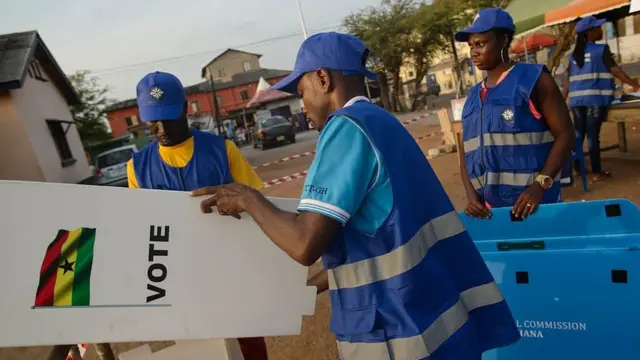
Polling stations open at 7:00 am and close at 5:00 pm, unless there are special circumstances. Voters queue and are processed one at a time. Each voter presents their voter ID card, and the polling officials verify the name against the register.
The voter’s name is checked against the register. The voter is then issued with a ballot paper or papers — one for the presidential election and one for the parliamentary election. The voter goes to a voting booth, marks the ballot in secret, and places it in the ballot box.
The secrecy of the ballot is protected by law. No one is permitted to see how another person has voted, unless the voter chooses to reveal it. The ballot papers are designed to allow a simple mark, such as a thumbprint or a cross, against the candidate of choice.
Special Voting
The Electoral Commission provides for special voting for certain groups who will be unable to vote on the main election day. These groups include election officials, security personnel, and media personnel who will be on duty. Special voting is held a few days before the main election.
How Votes Are Counted and Results Declared
Counting begins immediately after the close of polls, at the polling station. The ballots are counted in the presence of party agents, observers, and the general public. The results are recorded on a results form, which is signed by the presiding officer and the party agents.
The results are then sent to the constituency collation centre. The returning officer for the constituency compiles the results from all polling stations and declares the parliamentary result for that constituency. Presidential results are forwarded to the Electoral Commission headquarters in Accra.
The Chairperson of the Electoral Commission is the returning officer for the presidential election. The Commission collates the results from all constituencies and declares the outcome. The declaration typically takes place within a few days of polling day.
Party agents are present at every stage of the process. They observe the counting and collation, sign results forms, and can raise objections. Their presence is intended to provide transparency and build confidence in the results.
Election Observation
Election observation is a significant feature of Ghana’s electoral process. Domestic observer groups, such as the Coalition of Domestic Election Observers, deploy observers across the country. International observers, including delegations from the African Union, ECOWAS, the Commonwealth, and the European Union, are often invited.
Observers do not run the election. They watch the process, record what they see, and issue reports. Their presence provides an additional layer of scrutiny and can help deter misconduct.
Political parties also deploy their own agents to polling stations and collation centres. Party agents have the right to be present during voting and counting and to sign results forms. Their role is to protect their party’s interests and to verify that the process is fair.
Election Offences
The law defines a range of election offences, including:
-
Impersonating a voter
-
Voting more than once
-
Registering more than once
-
Bribery of voters
-
Undue influence
-
Disturbing a polling station
-
Forging ballot papers
-
Destroying ballot boxes
-
Publishing false results
Those who commit election offences can be prosecuted and, if convicted, may be disqualified from voting or standing for office for a period. The security agencies have the responsibility to maintain order and enforce the law during elections.
How Election Disputes Are Resolved
Parliamentary Election Disputes
A person who is dissatisfied with the result of a parliamentary election can file a petition in the High Court. The petition must be filed within 21 days of the declaration of the result. The High Court hears the case and can uphold the result, overturn it, or order a fresh election.
Presidential Election Disputes
A presidential election petition must be filed in the Supreme Court. The petition must be filed within 21 days of the declaration of the result. The Supreme Court has original jurisdiction over presidential election disputes, and its decision is final.
The courts have played a major role in Ghana’s electoral history. In 2012, the Supreme Court heard a challenge to the presidential election result and upheld the declaration after a lengthy trial. The willingness of candidates to use the courts rather than the streets has been an important factor in Ghana’s stability.
Political Parties
Political parties are essential to the electoral process. They nominate candidates, campaign, and provide a framework for political participation. The Electoral Commission registers political parties, and the Constitution guarantees the right to form parties.
Ghana has a multi-party system. Several parties contest elections, though two parties — the New Patriotic Party and the National Democratic Congress — have dominated the political landscape since the early 1990s. Other parties, including the Convention People’s Party and the People’s National Convention, have a longer history but smaller electoral support.
Parties campaign across the country, holding rallies, engaging with the media, and presenting their manifestos. The campaign period is regulated by law, and there are rules about the use of state resources, hate speech, and political advertising.
The Transition of Power
One of Ghana’s most important democratic achievements is the peaceful transfer of power. When a new President is elected, there is a formal transition process. The outgoing administration prepares handover notes, and the incoming administration reviews them. The transfer of power is conducted through legal and administrative mechanisms, not by force or uncertainty.
The Constitution sets the dates for the election and the swearing-in of the President. The President-elect takes the oath of office on 7 January following the election. This fixed date provides certainty and stability.
Common Misconceptions
“The Electoral Commission can do whatever it wants”
No. The Electoral Commission is bound by the Constitution and by election laws. Its decisions can be challenged in court. The Commission has significant powers, but it is not above the law.
“Only party members can vote in primaries”
Internal party elections are separate from national elections. To vote in national elections, you do not need to belong to a political party. Any registered voter can vote, regardless of party affiliation.
“A candidate with the most votes always becomes President”
Not necessarily. A presidential candidate must receive more than 50% of the valid votes to win in the first round. If no candidate crosses that threshold, a run-off is held.
“Once results are declared, there is nothing anyone can do”
Results can be challenged. Parliamentary results are challenged in the High Court, and presidential results in the Supreme Court. The courts can overturn results if there is sufficient evidence of irregularities.
“Voting is compulsory”
Voting is a right, not a legal obligation. No one is forced to vote. However, voting is an important civic duty, and high turnout strengthens the legitimacy of the outcome.
Frequently Asked Questions
How often does Ghana hold elections?
General elections are held every four years. Parliamentary and presidential elections are held on the same day, though the results are declared separately.
What is the minimum voting age?
The minimum voting age is 18. You must also be a Ghanaian citizen and a registered voter.
How many constituencies are there in Ghana?
The number of constituencies has changed over time as the population has grown. As of the most recent changes, Ghana has 275 constituencies. Check the Electoral Commission for the current figure.
What is a run-off?
A run-off is a second round of voting held when no presidential candidate receives more than 50% of valid votes in the first round. The top two candidates compete in the run-off.
Can I vote without a voter ID card?
The rules may vary depending on the Electoral Commission’s regulations for a given election. In general, you should bring your voter ID card. If you have lost it, check with the Electoral Commission about replacement procedures well before election day.
How are election results challenged?
Parliamentary results are challenged in the High Court. Presidential results are challenged in the Supreme Court. Petitions must be filed within 21 days of the declaration of results.
Who can observe elections in Ghana?
Domestic and international observers can observe elections if they are accredited by the Electoral Commission. Political parties also deploy agents to polling stations.
What to Remember
Ghana’s electoral system is built on the principle that power belongs to the people and is exercised through free, fair, and regular elections. The machinery of elections — registration, nomination, voting, counting, and dispute resolution — is designed to give effect to that principle.
Elections are not just about election day. They involve preparation, participation, scrutiny, and accountability. The voter’s role does not end when the ballot is cast. Citizens help protect the integrity of the process by staying informed, rejecting misinformation, and respecting the rule of law.
The next time you hear about the voters’ register, a nomination dispute, or a run-off, you will understand what is happening and why it matters. You will know that democracy is not a single event but a continuous process — and that the strength of that process depends on citizens who understand it and take part.
Source: The Accra Daily Mail

Samuel Kwame Boadu is a Ghanaian media entrepreneur and storyteller with a passion for amplifying urban voices and uncovering everyday truths. He is the Editor-in-Chief and Founder of The Accra Daily Mail, a dynamic digital platform dedicated to capturing the pulse of Ghana’s capital—its people, culture, challenges, business, sports and innovations.