







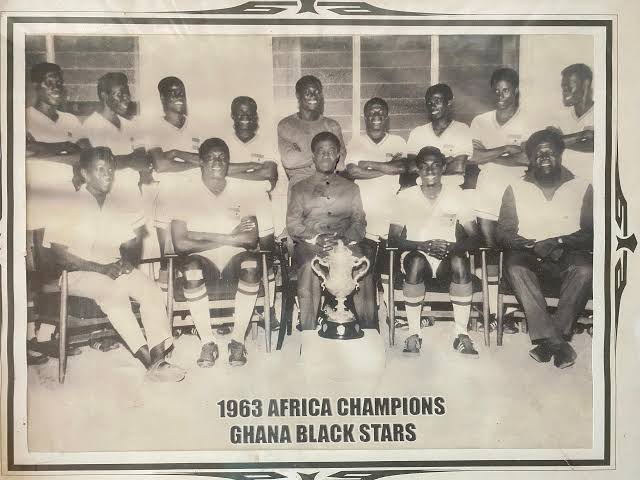
The Africa Cup of Nations is the tournament that defined Ghanaian football long before the World Cup became a realistic ambition. It is the competition where the Black Stars built their reputation, won their greatest honours, and experienced some of their most painful defeats.
Ghana’s relationship with AFCON is complicated. The country won the tournament four times, a record that places it among the most successful nations in the competition’s history. Yet the last of those triumphs came in 1982. Since then, Ghana has reached several finals and come agonisingly close, but the fifth title has remained elusive.
This article tells the story of Ghana at the Africa Cup of Nations. It covers the early dominance, the years of struggle, the modern near-misses, and the meaning of the tournament for Ghanaian football. It is written for the ordinary fan who wants to understand the journey.
Quick Facts
-
Ghana has won the Africa Cup of Nations four times: 1963, 1965, 1978, and 1982.
-
Ghana has also finished as runners-up five times: 1968, 1970, 1992, 2010, and 2015.
-
The Black Stars have hosted the tournament on multiple occasions, including the victorious campaigns of 1963 and 1978.
-
Ghana’s most recent AFCON final appearance was in 2015, when the team lost on penalties to Côte d’Ivoire.
-
The team has produced some of the tournament’s greatest players, including Osei Kofi, Abedi Pele, and Asamoah Gyan.
-
Ghana’s AFCON history spans more than six decades and reflects the broader story of Ghanaian football.
The Early Years: Establishing a Power
Ghana entered the Africa Cup of Nations early in the competition’s history. The tournament was founded in 1957, the same year Ghana became independent. The coincidence of timing was significant: as a new nation emerged, it found in football a stage for asserting its identity.
The Black Stars of the early 1960s were a formidable team. Built around domestic talent and led by coaches who understood the Ghanaian game, the team played with confidence and flair.
1963: First Triumph on Home Soil
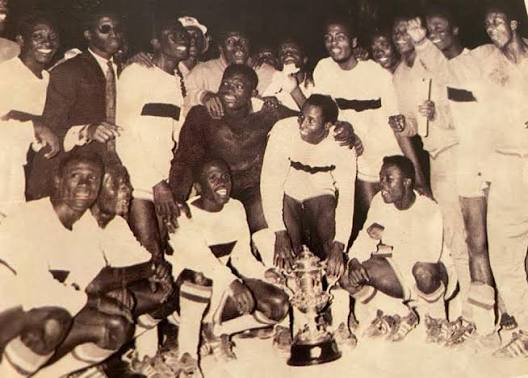
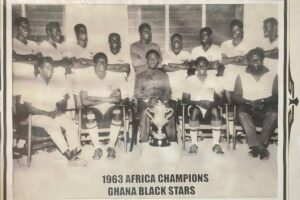
Ghana hosted the 1963 Africa Cup of Nations and won it. The victory was a landmark moment for the young nation.
The tournament featured six teams, including strong sides from Sudan, the United Arab Republic (Egypt), and Ethiopia. Ghana navigated the field with authority, winning the final against Sudan 3-0.
The goals came from Edward Aggrey-Fynn, Edward Acquah, and Wilberforce Mfum, but the victory was a collective achievement. The team was built on a solid defence, a creative midfield, and a sharp attack.
The 1963 triumph announced Ghana as a football power. It gave the nation a sense of pride and placed the Black Stars at the centre of African football.
1965: Defending the Crown
Two years later, Ghana travelled to Tunisia to defend its title. The team was changed but still strong. New players had emerged, and the core of experienced stars remained.
Ghana reached the final again and faced the United Arab Republic, the team it had defeated in the group stage two years earlier. The final was tense, but Ghana won 3-2 after extra time.
The victory made Ghana the second team to win consecutive AFCON titles, following Egypt’s earlier achievement. It confirmed that the 1963 triumph was not an isolated success.
The Near-Misses of the Late 1960s
The late 1960s brought frustration. Ghana reached the final of the 1968 AFCON in Ethiopia but lost to Congo-Kinshasa (now the Democratic Republic of the Congo). Two years later, in Sudan, Ghana reached the final again and lost to the host nation.
These defeats were painful. The team was still among the best in Africa, but the ultimate prize had slipped away. The near-misses foreshadowed a pattern that would repeat itself decades later.
The 1978 Triumph: Winning at Home Again
The 1970s were a mixed period for Ghanaian football. The national team remained competitive, but political and economic challenges affected the game. Yet by the late 1970s, a new generation of talent had emerged.
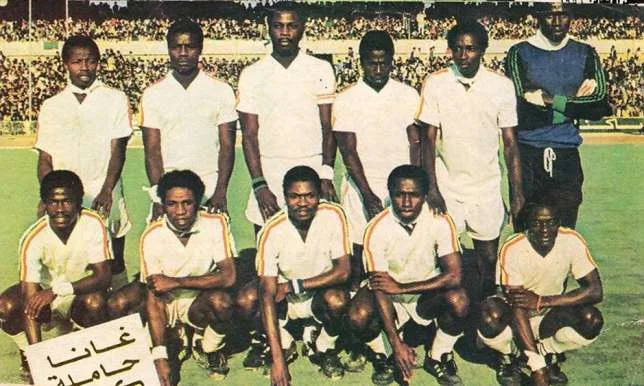
Ghana hosted the 1978 Africa Cup of Nations and won it. The tournament was played in Accra and Kumasi, and the home support was a powerful factor.
The Black Stars defeated Uganda 2-0 in the final. The goals came from Opoku Afriyie and Karim Abdul Razak, two of the stars of the team. The victory restored Ghana’s place at the summit of African football and gave the country its third continental title.
1982: The Fourth Crown
The 1982 Africa Cup of Nations was held in Libya. Ghana arrived as one of the contenders but not necessarily the favourite. The team had quality but faced strong opposition.
The tournament was difficult. Ghana navigated the group stage and the knockout rounds with resilience and tactical intelligence. The final was against the host nation, Libya, in a charged atmosphere.
The match ended 1-1 after extra time. Ghana won the subsequent penalty shootout, securing the fourth AFCON title in the country’s history. The victory was built on character as much as skill.
The 1982 triumph remains Ghana’s last AFCON title. More than four decades have passed, and the wait continues.
The Long Drought: 1984 to 1990
The mid-1980s brought decline. Ghana failed to qualify for AFCON in 1984 and 1986, a significant fall from the heights of the previous decade. The team’s absence from the tournament was a sign of deeper problems in Ghanaian football.
The late 1980s brought modest improvement. Ghana returned to AFCON in 1990 but did not progress far. The team was rebuilding, and the dominant years seemed distant.
Yet underneath the senior team’s struggles, something important was happening. Ghana’s youth teams were thriving, winning the FIFA Under-17 World Championship in 1991 and 1995. These victories produced a generation of players who would later lead the senior team back to prominence.
1992: The Return to the Final
The 1992 Africa Cup of Nations in Senegal marked Ghana’s return to the top of African football. The Black Stars, built around a blend of experienced players and young talent, reached the final.
The final against Côte d’Ivoire was tight and goalless after extra time. The match went to penalties, and Ghana lost 11-10 in one of the longest shootouts in tournament history. The defeat was heartbreaking.
Despite the loss, the 1992 campaign restored Ghana’s status as a continental force. The team had shown that it could compete at the highest level again.
The Inconsistent 1990s and 2000s
The remainder of the 1990s was inconsistent. Ghana qualified for AFCON regularly but did not reach the final. The team showed flashes of quality but could not sustain a challenge.
The early 2000s continued this pattern. Ghana reached the quarter-finals in 2000 and 2002 but fell short of the title. The focus of Ghanaian football was shifting, with the World Cup becoming a new ambition.
In 2006, Ghana qualified for the World Cup for the first time. The same year, the team competed in AFCON but did not win. The continental title remained elusive.
2008: Hosting and Falling Short
Ghana hosted the 2008 Africa Cup of Nations. The tournament was a major event, and expectations were high.
The Black Stars played well and reached the semi-finals, where they lost to Cameroon. The defeat was a disappointment, but the tournament was considered a success organisationally. Ghana had shown it could host a major event.
2010: Final Heartbreak in Angola
The 2010 Africa Cup of Nations in Angola produced another near-miss. Ghana, coached by Milovan Rajevac, reached the final with a team built on defensive discipline and moments of quality.
The final was against Egypt, the dominant team of the era. Ghana lost 1-0 to a late goal. The defeat was painful, especially because the team had been so close.
The 2010 final was part of a remarkable year for Ghanaian football. Later that year, the Black Stars reached the World Cup quarter-finals. The two campaigns reflected the team’s quality and its inability to win the decisive moment.
2015: The Penalty Pain Again
The 2015 Africa Cup of Nations in Equatorial Guinea produced Ghana’s most recent final appearance. The Black Stars, coached by Avram Grant, reached the final after a series of strong performances.
The final was against Côte d’Ivoire, a rematch of the 1992 final. The match ended 0-0 after extra time, and the tournament was decided on penalties. Ghana lost 9-8 in a shootout that echoed the pain of 1992.
The defeat was cruel. Ghana had been one of the best teams in the tournament and had come within a single kick of the title. The wait for a fifth title continued.
The Years Since 2015
Since the 2015 final, Ghana’s AFCON performances have been mixed. The team has qualified for the tournament but has not reached the latter stages consistently.
The 2017 and 2019 tournaments brought early exits. The 2021 edition, played in 2022 due to the COVID-19 pandemic, ended in the group stage. The 2023 tournament, held in early 2024, also ended early.
These results have frustrated fans accustomed to success. The team remains talented, but the consistency and tactical edge of previous generations have been harder to find.
The Great Players of Ghana’s AFCON History
Osei Kofi
Osei Kofi was a star of the 1960s, known for his pace, skill, and goalscoring. He was a key figure in the 1963 and 1965 triumphs.
Wilberforce Mfum
Mfum scored in the 1963 final and was one of the most dangerous forwards of his era.
Abedi Pele
Abedi Pele won the AFCON title with Ghana in 1982 as a young player and later became one of Africa’s greatest footballers. His creativity and elegance defined an era.
Opoku Afriyie
Opoku Afriyie scored in the 1978 final and was a prolific striker during his career.
Karim Abdul Razak
Abdul Razak was a midfield star of the late 1970s and a key figure in the 1978 triumph.
Asamoah Gyan
Asamoah Gyan represented Ghana at multiple AFCON tournaments and scored important goals, though the title eluded him.
André Ayew
André Ayew has been a central figure in Ghana’s AFCON campaigns since 2008, captaining the team and leading by example.
The Meaning of AFCON for Ghana
The Africa Cup of Nations holds a special place in Ghanaian football. It is the tournament where the Black Stars built their legend. The four titles are a source of pride and a benchmark for future generations.
But AFCON is also a source of pain. The near-misses — 1968, 1970, 1992, 2010, 2015 — have accumulated into a narrative of almost. The team has been good enough to reach finals but not quite good enough, or not quite fortunate enough, to win them.
For Ghanaian fans, the fifth title is more than a trophy. It is a completion of a journey, a fulfilment of a promise that has hung over the team for decades.
Common Misconceptions
“Ghana is no longer a strong AFCON team”
Ghana remains competitive, but the gap between the top teams has narrowed. The era of easy dominance is over for everyone, not just Ghana.
“The 1992 and 2015 finals were the same”
They were both penalty shootout losses to Côte d’Ivoire, but the teams, contexts, and details were different. The pain, however, was similar.
“Ghana has only won AFCON because of home advantage”
Ghana won two titles at home (1963 and 1978) and two away (1965 in Tunisia and 1982 in Libya). The record is balanced.
“The current team cannot compete with the great teams of the past”
Comparisons across eras are difficult. The game has changed, and the challenges are different. The current team faces its own pressures and has its own strengths.
“AFCON no longer matters because of the World Cup”
AFCON remains immensely important to African football and to Ghanaian fans. The World Cup is a bigger global stage, but AFCON is the continental championship.
Frequently Asked Questions
How many times has Ghana won AFCON?
Ghana has won the Africa Cup of Nations four times: 1963, 1965, 1978, and 1982.
How many times has Ghana been runner-up at AFCON?
Ghana has finished as runner-up five times: 1968, 1970, 1992, 2010, and 2015.
When did Ghana last win AFCON?
Ghana last won the tournament in 1982.
When did Ghana last reach an AFCON final?
Ghana’s most recent final appearance was in 2015, when the team lost on penalties to Côte d’Ivoire.
Who are Ghana’s greatest AFCON players?
Great players include Osei Kofi, Abedi Pele, Opoku Afriyie, Karim Abdul Razak, Asamoah Gyan, and André Ayew, among others.
Why has Ghana not won AFCON since 1982?
There is no single reason. The team has reached several finals but lost narrowly. Changes in African football, administrative challenges, and fine margins all contribute.
Will Ghana host AFCON again?
The possibility exists, but hosting rights are determined by the Confederation of African Football. Ghana hosted in 1963, 1978, and 2008.
What to Remember
Ghana’s AFCON journey is a story of glory, resilience, and heartbreak. The four titles place the Black Stars among the greatest teams in African football history. The near-misses since 1982 have added a layer of longing to the story.
For Ghanaians, AFCON is not just a tournament. It is a measure of national pride, a reminder of what the country has achieved, and a hope for what it can still become.
The wait for a fifth title continues. When the Black Stars finally lift the trophy again, the celebration will be the culmination of decades of hope. Until then, the journey goes on — one tournament at a time.
Source: The Accra Daily Mail

Samuel Kwame Boadu is a Ghanaian media entrepreneur and storyteller with a passion for amplifying urban voices and uncovering everyday truths. He is the Editor-in-Chief and Founder of The Accra Daily Mail, a dynamic digital platform dedicated to capturing the pulse of Ghana’s capital—its people, culture, challenges, business, sports and innovations.