



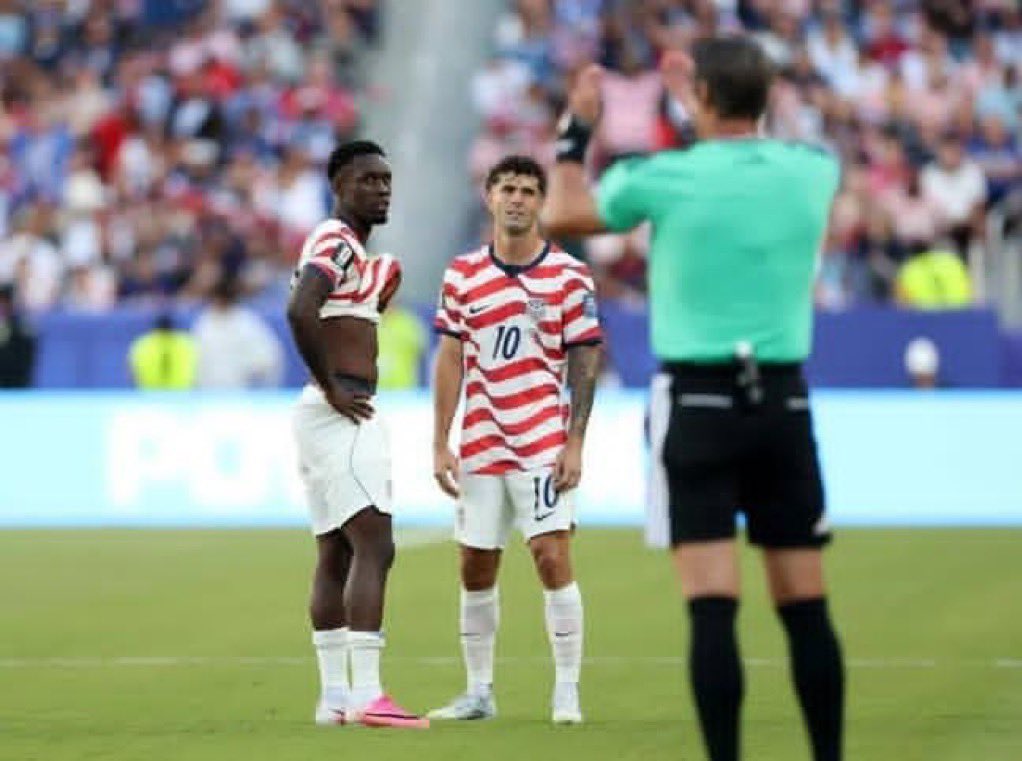

One of the biggest controversies of the 2026 FIFA World Cup has erupted around United States striker Folarin Balogun, with FIFA facing intense criticism after overturning his automatic suspension following reported intervention from the White House.
The drama began during the United States’ 2-0 Round of 32 victory over Bosnia and Herzegovina, when Balogun was shown a straight red card after a VAR review concluded he had stamped on defender Tarik Muharemović. Under FIFA’s disciplinary regulations, the dismissal carried an automatic one-match suspension, ruling the Arsenal forward out of the Americans’ Round of 16 clash against Belgium.
However, the story took an extraordinary turn when reports emerged that U.S. President Donald Trump personally contacted FIFA President Gianni Infantino, urging football’s governing body to reconsider the decision. Senior White House officials were also said to have lobbied FIFA, arguing that Balogun’s dismissal was unjust and that the punishment would unfairly affect the United States’ World Cup campaign.
Days later, FIFA’s disciplinary committee announced that while Balogun’s red card would remain on his record, his automatic one-match suspension had been suspended on probation under Article 27 of the FIFA Disciplinary Code, making him eligible to face Belgium.
The unprecedented decision immediately sent shockwaves through world football.
Belgium’s Football Association reacted with disbelief, launching legal and disciplinary challenges against FIFA’s ruling and questioning the consistency of the governing body’s disciplinary process. UEFA also weighed in, describing the decision as “unprecedented, incomprehensible and unjustifiable,” warning that it risked undermining the integrity and credibility of international football.
The controversy has since become one of the defining talking points of the 2026 FIFA World Cup. Critics argue that overturning an automatic suspension after reported political intervention creates the perception that powerful football nations receive preferential treatment, while supporters of the decision insist FIFA simply corrected what they believed was an excessively harsh punishment.
The incident has also reignited debate over the independence of football’s governing bodies from political influence. Many football administrators, former players and analysts have questioned whether external pressure should ever play a role in disciplinary decisions at the sport’s biggest tournament.
Beyond Balogun’s availability for the United States, the affair could have lasting consequences for FIFA. The governing body now faces mounting pressure to explain how Article 27 was applied, clarify the circumstances under which automatic suspensions can be overturned, and reassure teams that disciplinary decisions will be applied consistently regardless of a nation’s political influence.
Whether Balogun’s suspension should have been lifted remains a matter of opinion. What is beyond dispute, however, is that FIFA’s decision has sparked one of the most heated debates of the tournament and placed the organisation’s commitment to transparency, fairness and sporting integrity under the global spotlight.

Samuel Kwame Boadu is a Ghanaian media entrepreneur and storyteller with a passion for amplifying urban voices and uncovering everyday truths. He is the Editor-in-Chief and Founder of The Accra Daily Mail, a dynamic digital platform dedicated to capturing the pulse of Ghana’s capital—its people, culture, challenges, business, sports and innovations.