


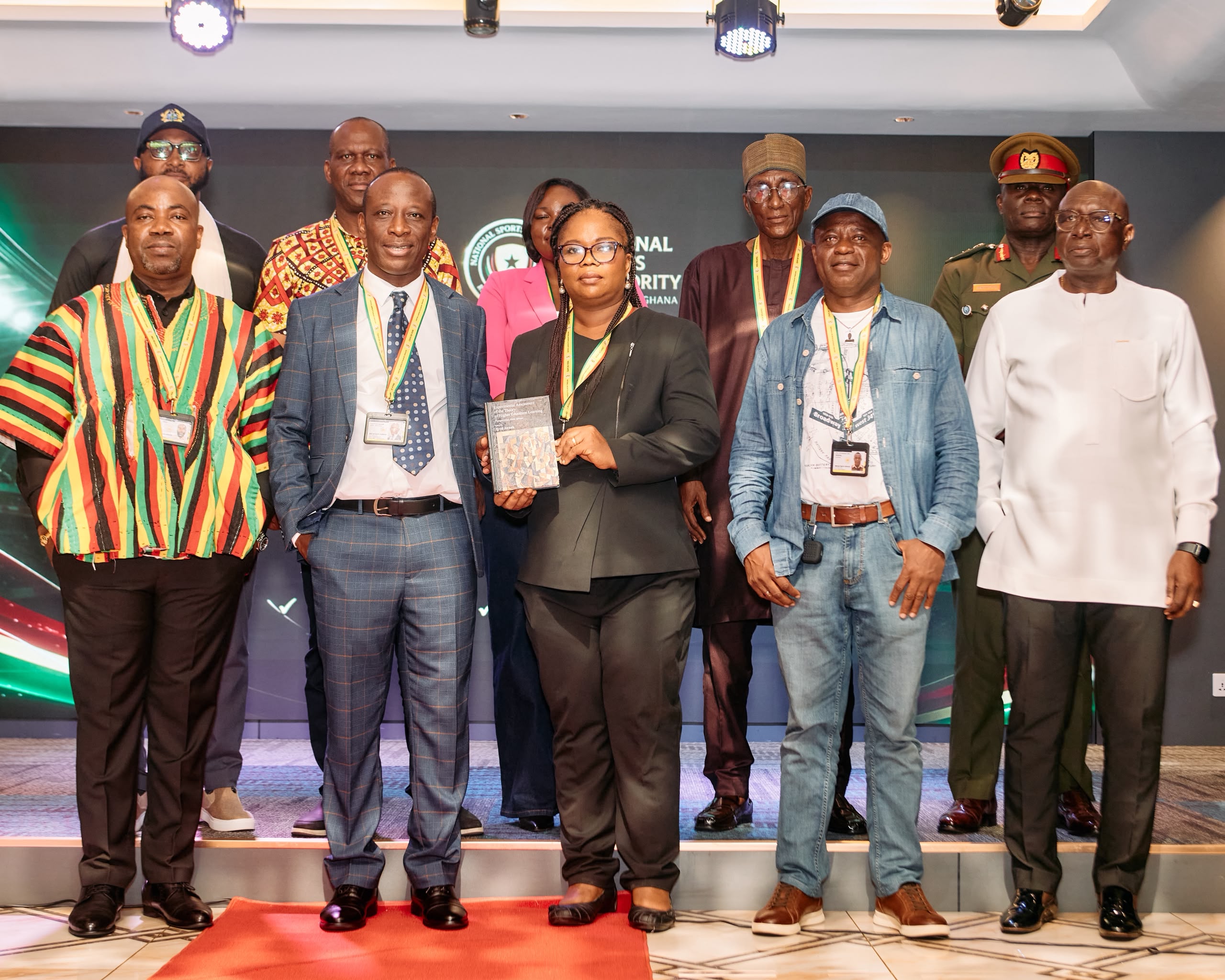

The inauguration of the National Sports Authority’s five-member Resource Mobilisation and Partnership Committee could prove to be one of the more significant developments for Ghanaian sports if its mandate is properly implemented and sustained. The event was held on Friday 14th August, 2026 at the ESP Hotel conference Room, Labone -Accra.
For many years, one of the biggest challenges confronting Ghanaian sports has been inadequate funding. While Ghana continues to produce talented athletes across football, athletics, boxing, swimming, rugby, badminton, table tennis and other disciplines, the country has often struggled to provide the resources required to turn that talent into consistent international success.
The new committee therefore arrives at a critical time.
With responsibility for mobilising resources for all 58 sports federations and associations, the committee has the potential to change how Ghana finances and prepares its athletes for major competitions.

FROM GOVERNMENT DEPENDENCE TO STRATEGIC PARTNERSHIPS
One of the most important long-term benefits could be a reduction in the heavy dependence on government funding.
Government will always remain an important stakeholder in sports development, but a modern sports system cannot rely on public funding alone. The committee’s ability to attract corporate Ghana, international organisations, philanthropists and strategic investors could provide federations with additional and more predictable sources of funding.

If successfully implemented, this could mean that federations are able to plan months or even years ahead instead of waiting until major competitions are approaching before searching for financial support.
That kind of planning could significantly improve Ghana’s international competitiveness.
BETTER EQUIPMENT, BETTER ATHLETES
Talent without the right equipment and training environment can easily remain unrealised potential.

The committee’s focus on identifying equipment and logistical needs across the various sporting disciplines is therefore particularly important.
For sports such as athletics, boxing, swimming, cycling, weightlifting, gymnastics and table tennis, access to modern equipment can make a major difference in athlete development.
In the long run, Ghana could see more athletes receiving specialised training and competing at international standards from a much earlier stage in their careers.
This could ultimately translate into more finalists, more podium finishes and more medals at the African Games, Commonwealth Games, Olympic Games and World Championships.
THE SAKORA PARK PROBLEM
The committee’s decision to examine the use of ungrassed pitches, popularly known as Sakora parks, is also significant.
For many young footballers, these pitches are the first and sometimes only places where they develop their skills. However, poor playing surfaces can affect player development, increase the risk of injuries and limit the quality of training.
A long-term strategy to improve community football pitches could therefore have an impact far beyond professional football.
If properly implemented, improved community facilities could create better environments for scouting and developing the next generation of Ghanaian footballers.
Inauguration of the Resource Mobilisation and Partnership (RMP) Committee
The five-member committee comprises:
- Mr. Samson Deen – Chairman
- Mr. Yaw Ampofo Ankrah – Co-Chairman
- Hajia Zenabu Sulemana – Member
- Alhaji Mutawakilu Iddrisu – Member
- Mavis Ekua Enyamah Kwainoe – Member/Secretary

A NEW APPROACH TO INTERNATIONAL COMPETITION
Perhaps the most important message from Committee Chairman Samson Deen is the call for Ghana to move from simply participating in international competitions to competing with the expectation of winning medals.
That change in mentality is crucial.
Ghana has regularly sent athletes and teams to major competitions, but the country has not always converted participation into medals. The problem is not necessarily a lack of talent; in many cases, preparation, funding, facilities, competition exposure and technical support have been inadequate.
The committee’s success should therefore ultimately be measured by outcomes.
How many athletes are being supported?
How many federations are receiving meaningful assistance?
How many athletes are qualifying for major competitions?
And most importantly, how many medals is Ghana winning?
WHAT THIS COULD MEAN FOR GHANA IN THE LONG RUN
If the committee succeeds in building sustainable partnerships and mobilising resources effectively, the impact could extend well beyond the current administration or the next major sporting competition.
Ghana could gradually develop a sports system where athletes receive support throughout their careers rather than only when they qualify for major competitions.
It could also encourage corporate Ghana to view sports not simply as an avenue for sponsorship visibility but as a long-term investment in talent development, youth employment, national pride and international recognition.
For Ghana’s federations, consistent access to resources could improve grassroots development, coaching, athlete welfare, international exposure and succession planning.
For athletes, it could mean better preparation and fewer financial barriers.
For coaches, it could mean access to modern training methods and equipment.
And for the country as a whole, it could mean a stronger pipeline of athletes capable of competing successfully on the global stage.
THE BIGGER PICTURE
The inauguration itself is only the beginning. The real test will be whether the committee can convert its mandate into measurable results.
Ghana has no shortage of sporting talent. What has often been missing is a sustainable system capable of identifying, developing, funding and supporting that talent all the way to the international podium.

The Resource Mobilisation and Partnership Committee has been given an opportunity to help close that gap.
If it succeeds, its work could become a foundation for a new era in Ghanaian sports one where talent is matched with resources, preparation is matched with ambition, and participation is ultimately matched with medals.
For Ghana Sports News, this is perhaps the most important question to watch in the coming years: Will the committee succeed in turning Ghana’s enormous sporting potential into sustainable international performance?
The answer will depend not on the inauguration ceremony, but on the partnerships it builds, the resources it mobilises and the tangible opportunities it creates for Ghanaian athletes.
By Achore Richard | Ghana Sports News

Samuel Kwame Boadu is a Ghanaian media entrepreneur and storyteller with a passion for amplifying urban voices and uncovering everyday truths. He is the Editor-in-Chief and Founder of The Accra Daily Mail, a dynamic digital platform dedicated to capturing the pulse of Ghana’s capital—its people, culture, challenges, business, sports and innovations.